Shift Management for Small Teams: Coverage, Swaps and Fairness
How many staff each shift needs, worked through for a 15-person restaurant, plus shift swap rules and ways to keep rosters fair.
Short answer: shift management is planning who works when, so every hour you are open has enough people without overworking anyone. For a small team, count the staff you need each hour, set shifts around the busy periods, add up the shifts needed in a week, divide by the shifts one person works (6 for a 48-hour week with one weekly off), then add a leave buffer of about 8 to 10%. After that, publish the roster early, set clear swap rules and rotate unpopular shifts fairly.
This guide is for owners and managers of restaurants, shops, clinics and small factories. It walks through a coverage calculation for a 15-person restaurant, a set of shift swap rules you can copy, and simple ways to keep shifts fair.
What is shift management?
Shift management is the work of deciding shift timings, putting the right people on each shift, handling changes such as swaps and leave, and making sure attendance and pay match what was actually worked. In a small business the owner or a store manager usually does all of it, often on WhatsApp and a paper roster.
| Part of the job | What it involves | When |
|---|---|---|
| Coverage planning | How many people you need, hour by hour, and so how many staff in total | When you open, add hours or see constant overtime |
| Rostering | Putting named people on shifts and weekly offs | Weekly or monthly |
| Changes | Swaps, leave, sick days, no-shows | Daily |
| Tracking | Checking who came on which shift, late marks, overtime, payable days | Daily, closed at month end |
Shifts can be fixed (the same people always on mornings) or rotating (people move between morning, evening and night). Rotation patterns are a topic of their own; this article focuses on how many people you need, how to handle swaps and how to keep things fair whichever pattern you use.
How do you plan shift coverage for a small team?
- Map demand by hour. Use your sales, footfall or order data to note how many staff each part of the day needs. Do weekdays and weekends separately.
- Set shift timings around the peaks. Each busy period should fall wholly inside one shift, so you aren't paying two shifts to cover one rush.
- Work out staff per shift. For each shift, take the highest number needed in the hours only that shift covers.
- Count weekly shift slots. Add up staff per shift for all seven days.
- Convert slots into headcount. Divide by the shifts one person works a week, after allowing for leave and absence.
- Compare with the team you have. A shortfall shows up as overtime, tired staff or gaps on the floor.
Worked example: how many staff does a 15-person restaurant need?
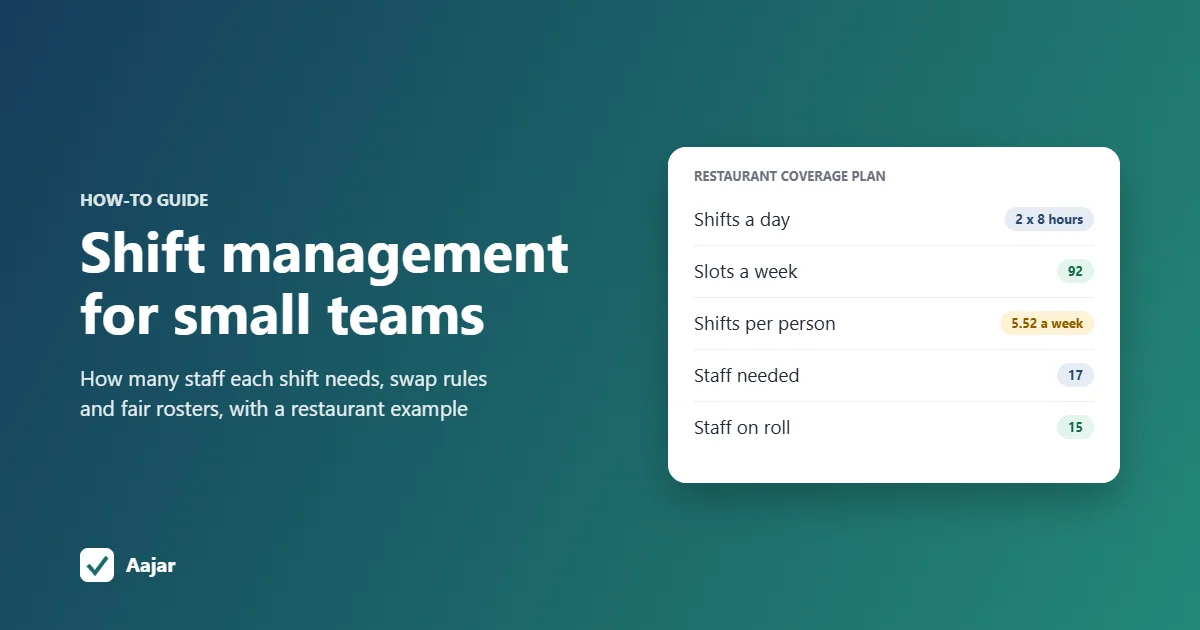
Take a restaurant open 11:00 to 23:00, seven days a week, with 15 kitchen and service staff (the owner-manager is not counted). It runs two shifts of 9 hours on site, each including a 1-hour meal break, so each person works 8 hours a shift.
- Morning: 09:30 to 18:30 (opening prep and lunch)
- Evening: 14:30 to 23:30 (dinner and closing)
The four-hour overlap in the afternoon is when both shifts take their meal breaks, the kitchen preps for dinner and the morning team hands over.
Step 1: staff needed by hour
| Time | What happens | Mon to Thu | Fri | Sat and Sun |
|---|---|---|---|---|
| 09:30 to 11:00 | Opening prep | 3 | 3 | 4 |
| 11:00 to 14:30 | Lunch | 6 | 6 | 7 |
| 14:30 to 18:30 | Afternoon, breaks, dinner prep | 5 | 5 | 6 |
| 18:30 to 22:00 | Dinner | 6 | 8 | 8 |
| 22:00 to 23:30 | Last orders and closing | 3 | 4 | 4 |
Step 2: staff per shift
The morning shift alone covers 09:30 to 14:30, so it needs the lunch peak: 6 on weekdays and 7 on weekends. The evening shift alone covers 18:30 to 23:30, so it needs the dinner peak: 6 from Monday to Thursday and 8 from Friday to Sunday.
Step 3: weekly shift slots
| Shift | Working | Slots a week |
|---|---|---|
| Morning | 6 × 5 weekdays + 7 × 2 weekend days | 44 |
| Evening | 6 × 4 (Mon to Thu) + 8 × 3 (Fri to Sun) | 48 |
| Total | 92 |
Step 4: headcount, with weekly offs and a leave buffer
Each person works 6 shifts a week with one weekly off. At 8 hours a shift that is 48 hours, the most a normal week can have under the OSH Code before overtime starts (PIB factsheet on the OSH Code).
People also take leave, fall sick and miss days. Assume each person is away for about 25 days a year out of 312 rostered days (52 weeks × 6): 25 ÷ 312 = 8%. Use your own figure from your leave policy and last year's absence.
| Calculation | Working | Result |
|---|---|---|
| Headcount with no leave at all | 92 ÷ 6 = 15.3 | 16 people |
| Shifts one person actually covers | 6 × (1 − 0.08) | 5.52 a week |
| Morning crew | 44 ÷ 5.52 = 7.97 | 8 people |
| Evening crew | 48 ÷ 5.52 = 8.70 | 9 people |
| Headcount needed | 8 + 9 | 17 people |
So the restaurant needs 17 people and has 15. Its 15 staff can cover 15 × 5.52 = 82.8 shifts a week against the 92 needed, a gap of about 9 shifts or 74 hours every week.
What does the gap cost?
If the gap is filled with overtime, it has to be with the workers' consent and paid at twice the normal wage (PIB factsheet). Say a cook earns ₹15,600 a month and your hourly rate is ₹15,600 ÷ 208 hours (26 days × 8) = ₹75, so overtime is ₹150 an hour.
- Overtime: 74 hours × ₹150 = ₹11,100 a week, or ₹11,100 × 52 ÷ 12 = ₹48,100 a month.
- Two more hires: 2 × ₹15,600 = ₹31,200 a month, before PF and ESI where they apply.
Here hiring is cheaper and avoids tired staff working 5 extra hours a week each. Companies use different bases for the hourly rate; see how to calculate overtime pay for the methods. One more point for this restaurant: the evening shift ends at 23:30, so women on it are working night hours (after 7 p.m.), which needs their consent and safety, facility and transport arrangements under the OSH Code (PIB factsheet).
What rules should you set for shift swaps?
Swaps keep staff happy, but unmanaged swaps are how a roster stops matching reality. Write a few rules down and share them with the team.
| Rule | Why it matters | Example |
|---|---|---|
| Ask at least 48 hours before the shift | Gives the manager time to check cover | A Saturday evening swap is agreed by Thursday evening. Emergencies go straight to the manager. |
| Swap only like for like | The shift still needs the same skills | A tandoor cook swaps only with someone who can run the tandoor; a cashier with a cashier. |
| Both people agree, the manager approves in writing | Avoids "I thought you said yes" | A message on the team group or a request in your app. No verbal swaps. |
| Stay within 6 shifts and 48 hours a week | Extra hours become overtime, which needs consent and double pay (PIB factsheet) | Someone already on 6 shifts can't take a seventh as a swap. |
| Keep a rest gap of at least 12 hours (house rule) | Closing then opening leaves people exhausted | No 23:30 close followed by a 09:30 open: that is only 10 hours. |
| Check consent and transport for women on late shifts | Work after 7 p.m. needs these under the OSH Code (PIB factsheet) | A woman taking an evening shift has given consent and a ride home is arranged. |
| Whoever takes the shift owns it | Clear responsibility for no-shows | If the replacement doesn't turn up, it is their absence, not the original person's. |
| Limit swaps to 2 per person a month | Keeps the roster recognisable | More than that is a sign the person's regular shift doesn't suit them; talk about changing it. |
| Update the roster and attendance the same day | Late marks and pay use the right shift timing | The manager changes both people's shift before the day starts. |
A swap moves a shift; it doesn't create a holiday. If someone works on their weekly off because of a swap gone wrong, handle it as overtime or a compensatory off under your policy.
How do you keep shifts fair?
Fairness complaints usually come from three things: closing shifts, weekends and festivals. In the restaurant above, weekend demand is so high that only 2 people can be off on each Saturday and each Sunday. That is about 4 weekend days off a week, or roughly 17 a month: enough for each of the 17 staff to get one weekend day off a month, but only if you plan it.
- Rotate the hard shifts. Share closing shifts and weekend work across the team instead of always giving them to the newest people.
- Keep a simple tally. For each person, count closing shifts, weekend days off and festival days worked each month, and balance them over the quarter.
- Publish the roster early. At least a week ahead, and a month ahead for festival periods like Diwali or Eid.
- Take preferences, but don't let them fix the roster. A student who can only work evenings is fine; a senior who never closes is not.
- Use the same rules for everyone. Swaps, leave and late marks should work the same way for every person on the shift.
Shift management in Excel or software?
With under 10 people and one shift, a sheet is enough; our guide to the attendance sheet in Excel has a layout and formulas you can adapt. Once you have two or more shifts, weekly offs on different days and regular swaps, the roster and the attendance sheet start to disagree, and month-end takes longer to fix.
Shift software keeps the shift timing, the check-in and the late mark in one place. Some tools also generate rosters or forecast demand; small teams can do without these if the coverage numbers above are worked out once and reviewed when business changes.
Shift management on Aajar
Shifts are part of Aajar's Growth plan (₹35 per user per month): you set your shift timings, such as morning and evening. The same plan adds overtime and comp-off requests with approvals, geofenced check-in and Excel exports, while weekly offs, late grace and half-day rules, leave and the live "who is in today" view are on every plan.
Plan coverage with the method above, agree swaps under your rules, and then update the shift in Aajar so attendance and payroll follow it. Every plan is free for the first 3 months for organisations with up to 50 users; see Aajar pricing.
Frequently asked questions
What is the role of a shift manager?
A shift manager runs the business during their shift: checks who has turned up, fills gaps from absences, assigns tasks and breaks, handles customer or production problems, and hands over to the next shift. In small teams they often approve swaps and note overtime for payroll.
What is a 4-3-3-4 shift schedule?
It is a two-week cycle, usually with 12-hour shifts: work 4 days, off 3, work 3, off 4. That averages 42 hours a week; the 3-4-4-3 schedule is the same cycle started from the other week.
What is the 5-2-2-5 shift schedule?
It is usually described as work 5 days, off 2, work 2, off 5, over a two-week cycle. With 12-hour shifts the 5-day block is 60 hours, above the 48-hour normal week under the OSH Code, so in India it would need overtime with consent or shorter shifts.
How many staff do I need per shift?
Take the highest number of people you need in the hours only that shift covers. To get total headcount, add up the weekly shift slots and divide by about 5.5 (6 shifts a week less a leave allowance).
Can employees swap shifts without the manager's approval?
It is better not to allow it. Ask for written approval so the manager can check skills, weekly hours and rest gaps, and update attendance so pay is calculated on the right shift.
This article is general information, not legal advice.
Keep reading
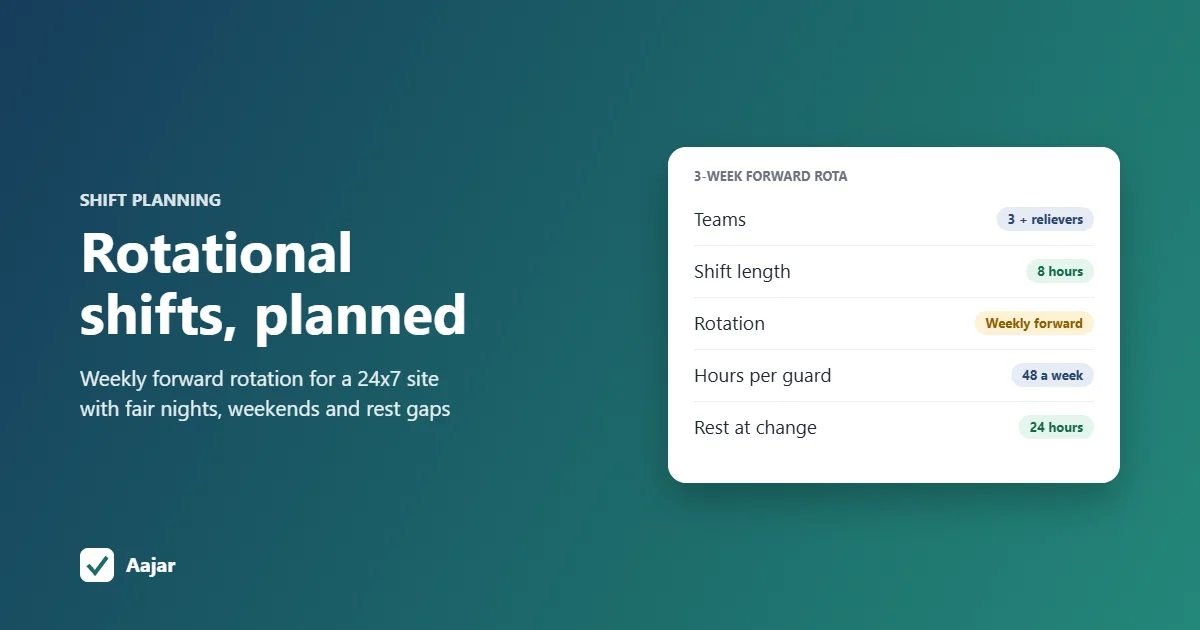
Rotational Shift: Patterns, Fair Planning and a 24x7 Example
Rotation patterns compared, a fair-planning checklist and a 3-week roster for a 24x7 site that stays within 48 hours a week.
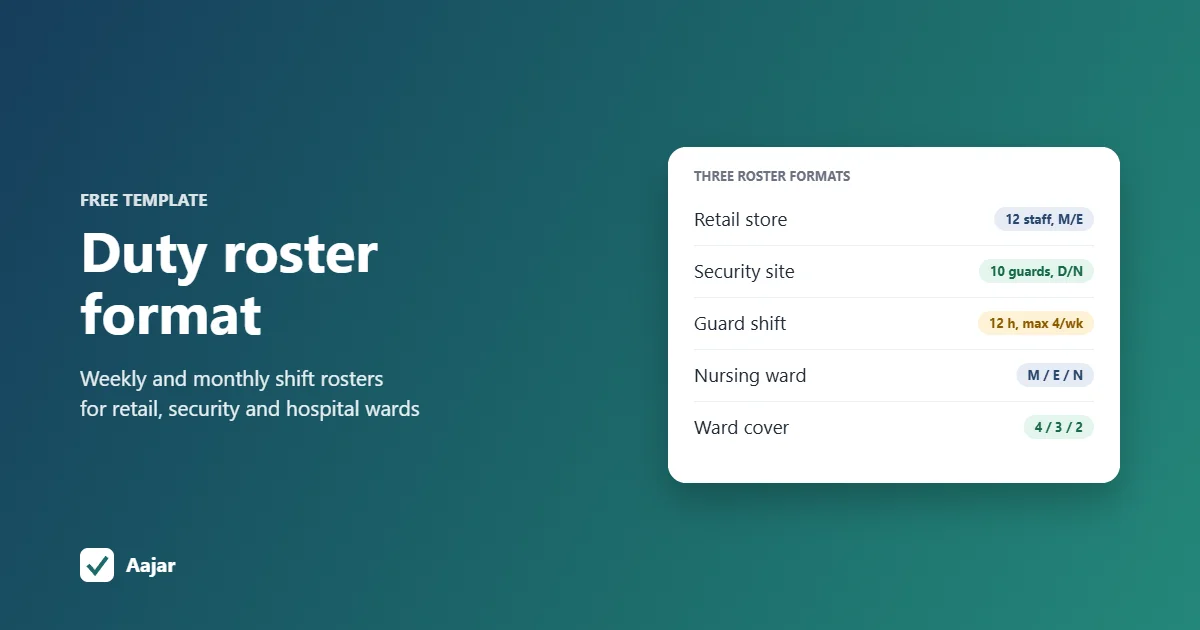
Duty Roster Format: Free Shift Roster Templates for Retail, Security and Hospitals
Three ready duty roster formats for retail, security and hospital wards, plus shift codes and Excel steps to build your own.
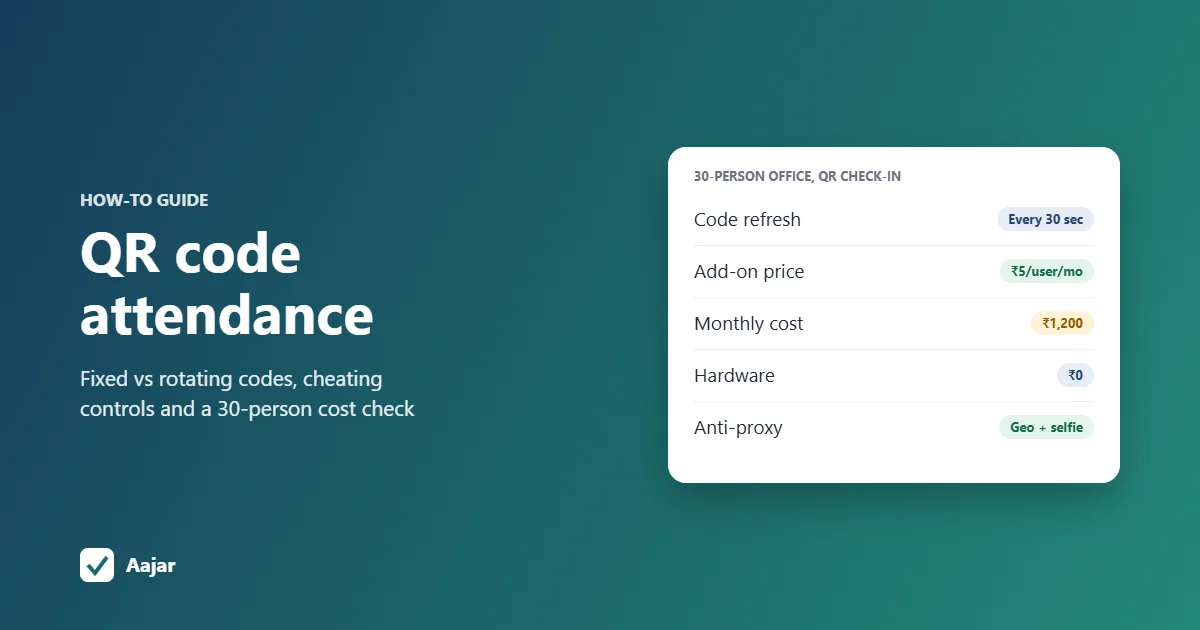
QR Code Attendance for Offices and Sites: Setup and Pitfalls
How QR check-in works for offices and sites, how people cheat it, when it beats a biometric machine, and how to set it up at your entrance.