Rotational Shift: Patterns, Fair Planning and a 24x7 Example
Rotation patterns compared, a fair-planning checklist and a 3-week roster for a 24x7 site that stays within 48 hours a week.
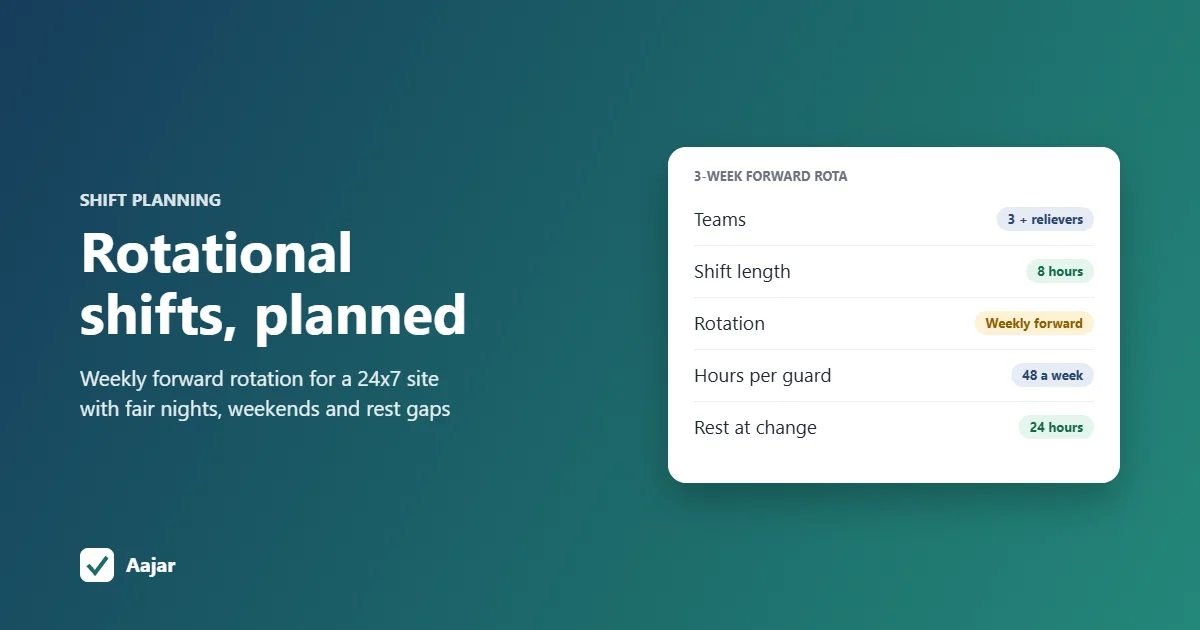
Short answer: a rotational shift means employees move between morning, evening and night shifts on a set schedule, often every week, so a 24x7 operation stays covered and no one is stuck on nights for good. To plan rotation fairly, rotate forward (morning to evening to night), leave a full rest gap at every change, share nights and weekends equally, and publish the roster in advance. Under the OSH Code, normal hours stay within 8 a day and 48 a week; anything more is overtime that needs the worker's consent and is paid at twice the normal rate.
This guide explains the common rotation patterns, how to plan a fair roster, a 3-week worked example for a 24x7 site, and the legal points to check.
What does rotational shift mean?
In a rotational shift system, the day is split into shifts (usually three shifts of 8 hours or two of 12 hours) and teams take turns working each one. A team that works mornings this week may work evenings next week and nights the week after.
It is common wherever work can't stop at 6 p.m.: BPOs and call centres serving other time zones, factories running continuous processes, hospitals and nursing homes, and security agencies guarding sites round the clock. Job ads often say "24x7 rotational shifts" for these roles.
Rotational shift vs night shift: what is the difference?
| Rotational shift | Fixed night shift | |
|---|---|---|
| Timing | Changes on a schedule (morning, evening, night) | Same night hours every working day |
| Nights worked | Only part of the time, shared across the team | All the time |
| Main difficulty | Adjusting sleep each time the shift changes | Staying awake at night and sleeping in the day, every day |
| Suits | Teams that must cover 24 hours and want to share nights fairly | People who prefer nights, often for a night allowance |
What are the common rotational shift patterns?
Most small businesses use either 8-hour shifts with weekly rotation or one of the 12-hour patterns used by factories and hospitals. The table compares the usual options.
| Pattern | Shift length | Teams | How it runs | Watch out for |
|---|---|---|---|---|
| Weekly rotation (A/B/C) | 8 hours | 3, plus relief | Each team moves to the next shift every week | Three teams working 7 days means 56 hours a week each, so you need weekly offs and relief cover |
| Fast rotation | 8 hours | 3 or 4 | The shift changes every 2 or 3 days | Easy to end up with a short gap between shifts if planned carelessly |
| 2-2-3 (Panama) | 12 hours | 4 | Over 14 days: 2 on, 2 off, 3 on, 2 off, 2 on, 3 off | One week of the two has 5 shifts, or 60 hours |
| 4-on-4-off | 12 hours | 4 | 4 shifts on, 4 days off, in an 8-day cycle | Long days; at most 4 shifts (48 hours) in any 7 days |
| DuPont | 12 hours | 4 | 28-day cycle: 4 nights, 3 off, 3 days, 1 off, 3 nights, 3 off, 4 days, 7 off | Some 7-day stretches have 6 shifts (72 hours); a full week off every cycle |
The 12-hour patterns average 42 hours a week, but the 48-hour limit is stated per week, not as an average. Check every week of the cycle before you adopt one (see the legal section below).
Forward vs backward rotation
Forward rotation moves in the direction of the clock: morning, then evening, then night. Backward rotation goes the other way: night, then evening, then morning. NIOSH's shift work training says forward rotations are easier to adjust to than backward ones (NIOSH, Training for Nurses on Shift Work, Module 5).
Backward rotation also squeezes rest. A worker who finishes an evening shift at 10 p.m. and starts a morning shift at 6 a.m. gets only 8 hours, including travel and sleep.
How do you plan rotational shifts fairly?
Fair rotation is mostly about three things: enough rest, equal sharing of the unpopular shifts, and no surprises. Use these steps when you draw up the roster.
- Count the headcount first. One post covered 24x7 needs 168 hours a week. At 48 hours per person, that is 3.5 people per post before any leave, so three people can't cover it without overtime.
- Rotate forward. Morning to evening to night, then back to morning after a rest day.
- Protect the gap at every change. NIOSH's training cites a suggestion of at least 11 hours between shifts (NIOSH, Module 5). The hardest change is night to morning, so put the weekly off there.
- Share nights and weekends equally. Every team should get the same number of night weeks and the same number of weekend days off over a full cycle.
- Give notice. Publish the roster at least a week or two ahead, and change it only by agreement, so people can plan sleep, family and travel.
- Get consent where the law needs it. Women on night shifts and anyone doing overtime must agree first (details below).
- Keep a written swap rule. Swaps should be approved by a supervisor and must not break the rest gap or push anyone past 48 hours.
Worked example: 3 teams covering 24x7 with weekly forward rotation
Take a warehouse that needs 2 security guards on duty at all times. The security agency uses three 8-hour shifts: morning (6 a.m. to 2 p.m.), evening (2 p.m. to 10 p.m.) and night (10 p.m. to 6 a.m.). Teams A, B and C have 2 guards each, and the rota week runs Saturday to Friday.
| Rota week | Morning | Evening | Night | Weekly offs |
|---|---|---|---|---|
| Week 1 | Team A | Team B | Team C | A: Saturday, B: Sunday, C: Monday |
| Week 2 | Team C | Team A | Team B | C: Saturday, A: Sunday, B: Monday |
| Week 3 | Team B | Team C | Team A | B: Saturday, C: Sunday, A: Monday |
Each team moves forward every week: A goes morning, evening, night; B goes evening, night, morning; C goes night, morning, evening. After week 3 the cycle repeats.
Check 1: are the hours within limits?
Without weekly offs, each team would work 7 shifts × 8 hours = 56 hours a week, which is 8 hours over the 48-hour limit. With one weekly off, each guard works 6 shifts × 8 hours = 48 hours in every rota week.
The offs leave three shifts a week without their regular team: Saturday morning, Sunday evening and Monday night. Two relievers cover them, so the site needs 8 guards in all. The arithmetic: 21 shifts × 2 guards = 42 guard-shifts a week; 6 guards × 6 shifts = 36, plus 2 relievers × 3 shifts = 6, which makes 42.
Check 2: is there enough rest at each change?
| Change | Last old shift ends | First new shift starts | Rest |
|---|---|---|---|
| Night to morning (C, into week 2) | Saturday 6 a.m. | Sunday 6 a.m. (Saturday is the off) | 24 hours |
| Morning to evening (A, into week 2) | Friday 2 p.m. | Saturday 2 p.m. | 24 hours |
| Evening to night (B, into week 2) | Friday 10 p.m. | Saturday 10 p.m. | 24 hours |
| Reliever | Saturday 2 p.m., then Sunday 10 p.m. | Sunday 2 p.m., then Monday 10 p.m. | 24 hours each time |
The reliever works morning, then evening, then night, so their week also rotates forward. If the night team's off fell on any other day, its guards would finish at 6 a.m. Saturday and be due back at 6 a.m. the same day.
Check 3: is it fair?
- Nights: every guard works one night week in three, which is 6 night shifts over the cycle.
- Weekends: every guard gets a Saturday off once and a Sunday off once in each 3-week cycle.
- The trade-off: because the off day moves one day later each week, a guard works 7 days in a row twice in the cycle, and 4 days once. Tell people this in advance, and check your state's rules on weekly holidays before you use this pattern.
The relievers work only 24 hours a week here, so they are your natural cover for leave and absences, or can be shared with a second site. If a guard covers an absent colleague on top of their 48 hours, that is overtime; see how to calculate overtime pay in India. Some agencies give a comp off instead where their policy allows.
What does the law say about rotational shifts?
The labour codes have been in force since 21 November 2025 (India Code: OSH Code, 2020). There is no separate law on rotation, but these rules from the PIB factsheet on the OSH Code shape any roster.
| Rule | What it means for a rotational roster |
|---|---|
| Normal hours up to 8 a day and 48 a week | Six 8-hour shifts is a full week. Plan weekly offs and relief so nobody goes over. |
| Overtime needs the worker's consent and is paid at twice the normal wage | Double shifts and extra cover are voluntary, and must be recorded and paid at 2x. |
| A 4-day week of 12 hours, a 5-day week of 9.5 hours or a 6-day week of 8 hours is possible without overtime | 12-hour patterns fit only in weeks of 4 shifts. Weeks with 5 or 6 twelve-hour shifts (as in 2-2-3 or DuPont) go beyond this. |
| Women may work night shifts (before 6 a.m. and after 7 p.m.) with their consent and with safety, facility and transport arrangements | Don't put a woman on the night rotation without her consent on file, and arrange safe transport for night shifts. |
| Rest intervals and spread-over are set by the appropriate government | Rules on breaks, spread-over and rest when changing shifts come from the central or state rules that apply to you. Check your state's labour department site. |
Sources checked on 18 October 2026. Overtime caps and shift-change rest rules differ between the central and state rules, so confirm the figures for your state before you fix the roster.
Is rotational shift work bad for health?
Shift work, especially at night, affects sleep. A NIOSH science bulletin notes that shift work is associated with sleep problems and with risks such as immune dysfunction, diabetes and cardiovascular disease, with night-shift workers at the highest risk of sleep problems (NIOSH Science Bulletin: Shift Work and Sleep).
Employers can't remove that risk, but the roster can reduce the strain: rotate forward, keep long rest gaps at each change, give some weekends off and avoid very early starts where possible. Employees with health concerns about night work should speak to a doctor.
Tracking rotational shifts: paper, Excel or software?
A small team on a stable rotation can manage with a roster on paper and an attendance sheet; our attendance sheet in Excel guide has a free layout. The trouble starts when you have swaps, relievers and overtime to reconcile each month.
Good shift software lets you define each shift's timing, assign people to shifts, see late arrivals against the right shift start and keep overtime approvals on record. Check how any tool you try handles night shifts that cross midnight, since the punch-in and punch-out fall on different dates.
Managing rotational shifts on Aajar
Aajar's Growth plan (₹35 per user per month) adds shifts, so you can set up your morning, evening and night shift timings. Overtime and comp-off requests with approvals, and Excel exports for month-end, are on the same plan. Plan the rotation in your roster first, then update shifts in Aajar when the rotation moves on.
Check-ins, late grace and half-day rules, leave and payroll with payslips work the same way on every plan. Every plan is free for the first 3 months for organisations with up to 50 users; see Aajar pricing.
Frequently asked questions
What do rotational shifts mean?
It means your working hours change on a schedule, for example morning one week, evening the next and night the week after. The employer uses rotation to cover 24 hours while sharing the night and weekend work across the team.
What is 24*7 rotational shift?
It is a job in an operation that runs round the clock, every day, where you may be put on any of the shifts. Your weekly off may also fall on different days, including weekdays.
Which is better, night shift or rotational shift?
Neither suits everyone. A fixed night shift lets you settle into one routine, while a rotational shift limits how many nights you work but means adjusting each time the shift changes; forward rotation with good rest gaps makes it easier.
Is rotational shift good for health?
Shift work, particularly at night, is linked to sleep problems and other health risks, according to NIOSH. A well-planned rotation reduces the strain, and anyone with health concerns should speak to a doctor.
Can women be put on a rotational shift that includes nights?
Under the OSH Code, women may work before 6 a.m. and after 7 p.m. with their consent and with safety, facility and transport arrangements in place. Keep the consent on file before adding anyone to the night rotation.
This article is general information, not legal advice.
Keep reading
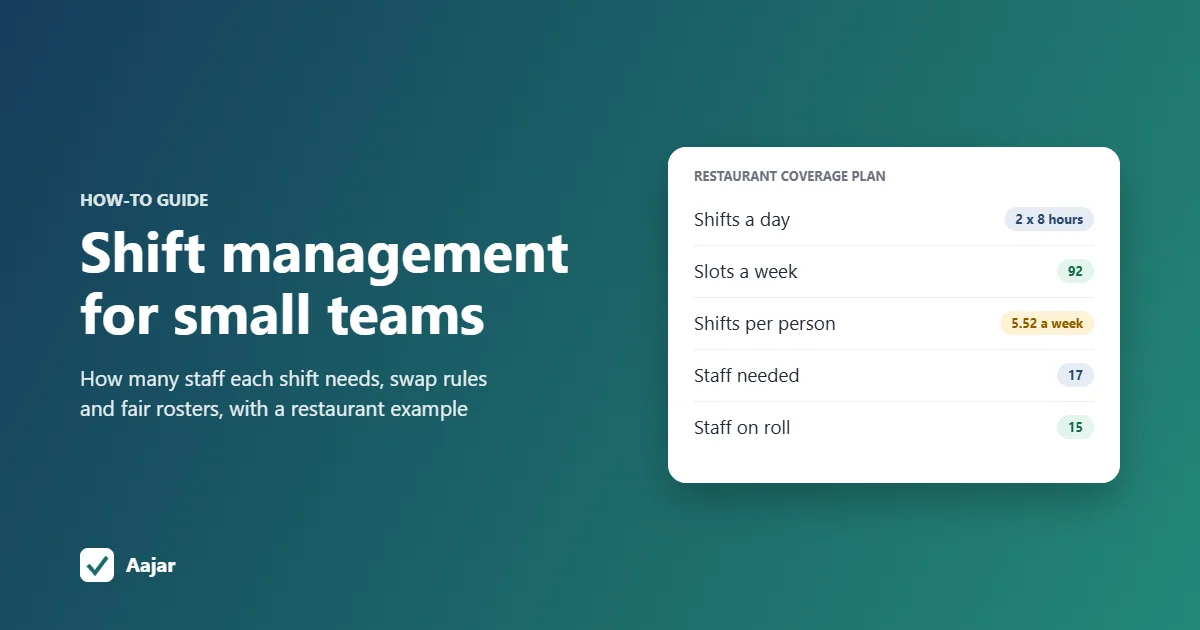
Shift Management for Small Teams: Coverage, Swaps and Fairness
How many staff each shift needs, worked through for a 15-person restaurant, plus shift swap rules and ways to keep rosters fair.
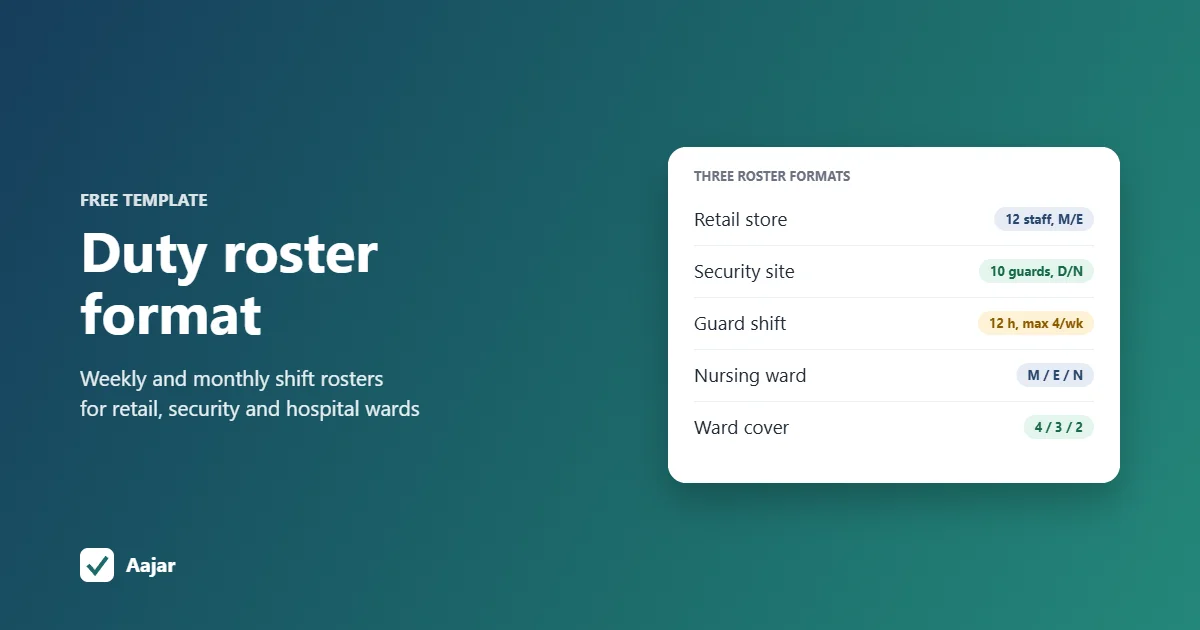
Duty Roster Format: Free Shift Roster Templates for Retail, Security and Hospitals
Three ready duty roster formats for retail, security and hospital wards, plus shift codes and Excel steps to build your own.
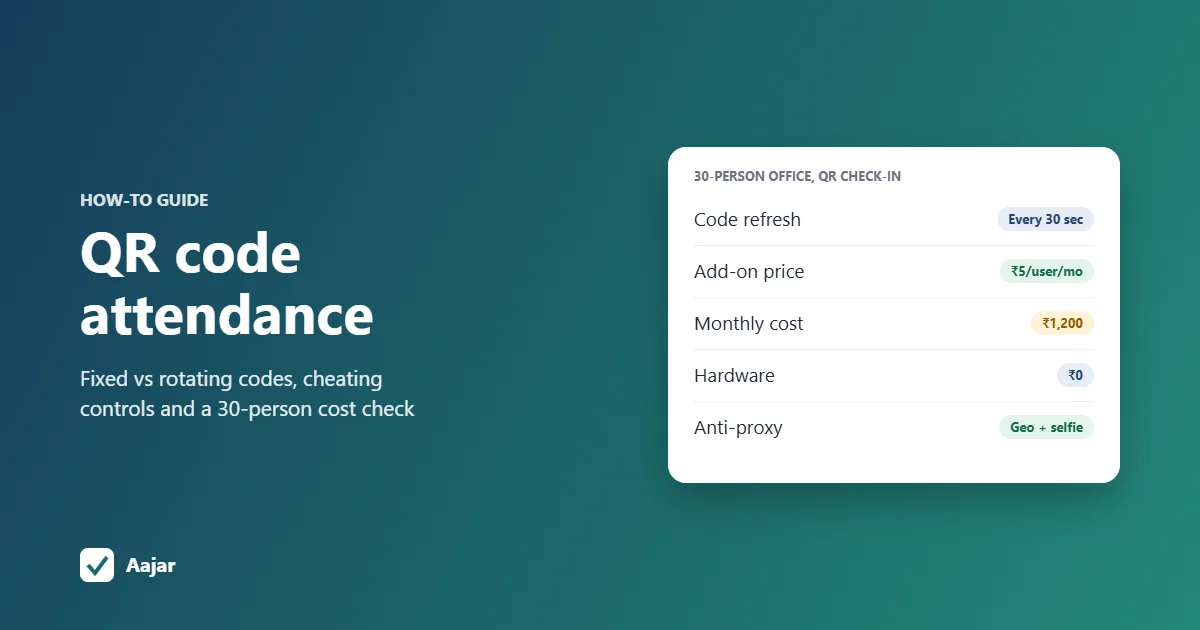
QR Code Attendance for Offices and Sites: Setup and Pitfalls
How QR check-in works for offices and sites, how people cheat it, when it beats a biometric machine, and how to set it up at your entrance.