Comp Off in India: Meaning, Rules and How to Track It
What comp off means, what the OSH Code and state shops acts say, the rules most Indian companies use, and how to track comp off balances.
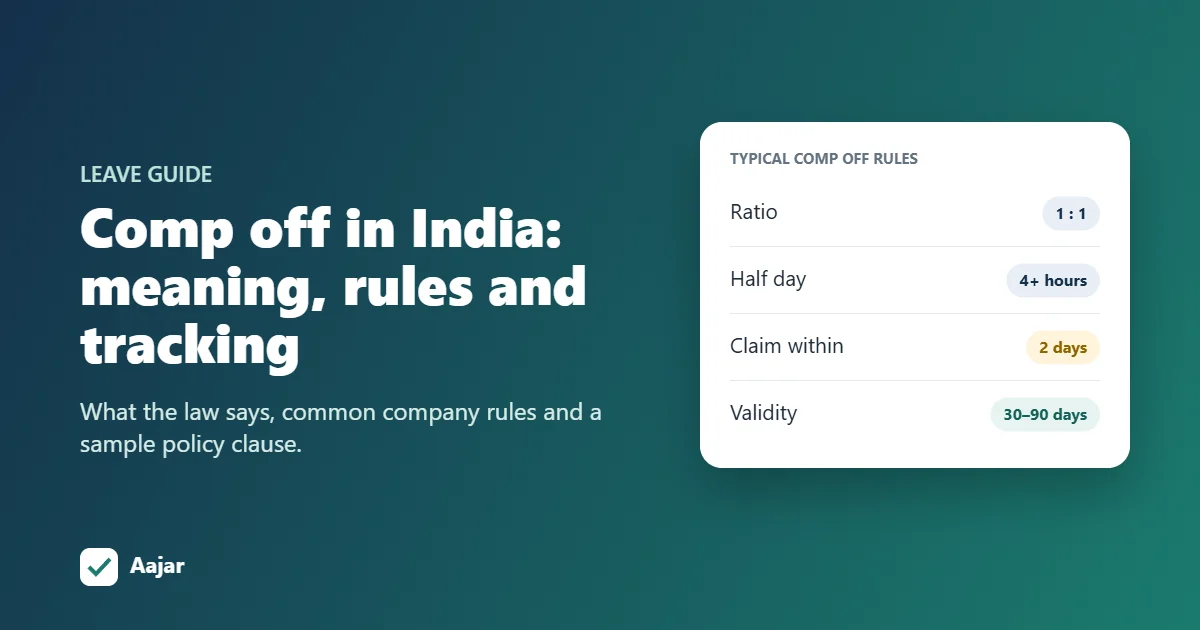
Short answer: comp off (compensatory off) is a paid day off given to an employee who worked on a weekly off or a holiday. In India it is mostly a matter of company policy. The only central law on it is Section 26(3) of the OSH Code, 2020, which requires compensatory holidays when an exemption makes a worker lose weekly holidays. Several state shops and establishments Acts also require a substitute holiday or double wages for work on a rest day or festival holiday. Most companies give comp off 1:1, ask for it to be claimed within a few days, and let it lapse after 30 to 90 days.
This guide explains what comp off means, what the law says, the rules most Indian companies use, and how to track it so balances don't get lost in WhatsApp messages and spreadsheets.
What does comp off mean?
Comp off is short for compensatory off. When an employee works on a day they would normally have off, such as a Sunday, a weekly off or a public holiday, they earn a day off to take later. It is also written as comp-off, compoff or CO on attendance sheets.
A typical example: a store manager works on Republic Day to handle a sale. The company credits one comp off to her leave balance, and she takes it the following Thursday. Her salary doesn't change, and Thursday isn't counted as leave.
Comp off vs overtime
Comp off and overtime are different things, and one doesn't replace the other.
| Comp off | Overtime | |
|---|---|---|
| What the employee gets | A paid day off later | Extra money |
| When it applies | Work on a weekly off or holiday | Work beyond the daily or weekly hours limit |
| Legal basis | Mostly company policy; OSH Code s.26(3) and some state Acts in specific cases | OSH Code s.27: twice the ordinary rate of wages, with the worker's consent |
| Who it usually covers | Office and managerial staff as well as workers | "Workers" as defined in the labour codes |
If a worker covered by the OSH Code works beyond 8 hours a day, that time is overtime and must be paid at double the ordinary rate, whether or not comp off is also given. See our guide on how to calculate overtime pay in India.
What the law says about comp off in India
OSH Code, 2020 (central law)
The Occupational Safety, Health and Working Conditions Code, 2020 has been in force since 21 November 2025 and replaced the Factories Act, 1948. On weekly holidays and compensatory holidays it says (OSH Code text, India Code):
- Section 26(1): no worker may be made to work more than six days in a week.
- Section 26(3): if a government exemption makes a worker lose any weekly holiday, the worker must be given the same number of compensatory holidays, within the month the holidays were due or the two months right after it.
- Section 27: overtime is paid at twice the ordinary rate of wages, and only with the worker's consent.
So central law requires compensatory holidays only in the exemption case. Comp off for working an occasional Sunday or holiday is mostly set by your state's law and your own policy.
State shops and establishments Acts
Shops, offices and other commercial establishments are governed by state shops and establishments Acts, which continue alongside the labour codes. Some examples:
| State | Work on a weekly off | Work on a festival or national holiday |
|---|---|---|
| Gujarat (2019 Act) | Compensatory leave within two months if the weekly holiday is denied (s.16(3)); double wages for work on a rest day (s.16(5)) | Double wages plus a substitute holiday (s.18(7)) |
| Maharashtra (2017 Act) | Compensatory leave within two months if the weekly holiday is denied; double wages for rest-day work | Double wages plus a day of leave |
| Karnataka (1961 Act) | At least one whole day of rest a week; the employer can't call employees in on the weekly holiday (s.12) | Covered by the state's National and Festival Holidays Act |
| Tamil Nadu (1947 Act) | One whole day off a week (s.16); no separate comp-off rule in the Act | Covered by the state's National and Festival Holidays Act |
| Telangana (1988 Act) | One whole day off a week (s.19) | Compensatory holiday within 30 days, for hotels, restaurants, theatres and similar businesses (s.31(2)) |
Sources: Gujarat Act, 2019; iPleaders on the Maharashtra Act; Karnataka Act; Tamil Nadu Act; Telangana Act. State Acts are amended from time to time, so check the current version for your state.
National and festival holidays are covered by separate state Acts. Under these, an employee who works on such a holiday usually gets double wages, or ordinary wages plus a compensatory day off.
Common comp off rules in Indian companies
Because the law leaves most details open, companies set their own rules. These are the most common choices; none of them is a legal requirement.
- Ratio: one comp off for one full day worked. Some companies give 1.5 or 2 days for work on a national holiday.
- Half-day comp off: 4 or more hours on a holiday earns half a day; 8 or more hours earns a full day.
- Claim window: the employee claims comp off within 24 to 48 hours of working the extra day, and a manager approves it.
- Prior approval: the work itself must be approved in advance, so people can't earn comp off by logging in on a Sunday without being asked.
- Validity: unused comp off lapses after 30, 60 or 90 days.
- Encashment: usually not allowed. If your policy allows it, the payout is taxable salary.
- Who is eligible: some companies give comp off only below a certain grade and pay overtime to workers instead.
Sample comp off policy clause
Employees who are asked by their manager to work on a weekly off or a declared holiday will earn compensatory off. Four or more hours of work earns half a day; eight or more hours earns a full day. Employees must apply for comp off within two working days of the day worked. Approved comp off must be used within 60 days, after which it lapses. Comp off cannot be encashed. This policy does not affect any overtime wages payable under law.
Adjust the numbers to match your state's Act and your business. Our leave policy template for Indian SMEs has the full policy this clause fits into.
How to track comp off
Comp off goes wrong in small businesses for predictable reasons: nobody records the day worked, the approval is in a chat, the balance lives in someone's head, and the day off is later marked as absent or as paid leave. A system needs to do four things:
- Record the day worked, linked to that person's attendance for the day.
- Route the claim to a manager and keep a record of the decision.
- Credit the balance only after approval.
- Let the employee spend it as a leave type, so the day off counts as paid and isn't deducted.
In Excel, that means a separate comp off column, a log of approvals, and a monthly check before payroll. In an attendance app, it happens on its own.
Comp off in Aajar
Aajar has comp off on the Growth plan (₹35 per user per month). An employee applies for comp off against the date they worked, with a reason. Their manager approves or rejects it, and each approved request adds one day of comp off to the employee's balance. The employee then applies for leave of type comp off, like any other leave, and the day is counted as paid in attendance and payroll. Validity periods and half-day comp off aren't automated yet, so set those rules in your written policy. See Aajar pricing; every plan is free for the first 3 months for teams of up to 50 users.
Frequently asked questions
What is the full form of comp off?
Compensatory off. It is a paid day off given in place of a weekly off or holiday that the employee worked.
Is comp off mandatory in India?
Not in every case. Central law requires compensatory holidays when an exemption causes a worker to lose weekly holidays (OSH Code s.26(3)). Some state shops and establishments Acts require compensatory leave or double wages when a weekly or festival holiday is worked. Beyond that, comp off is company policy.
How many days is comp off valid?
There is no national rule. Most companies set 30 to 90 days. Where a state Act applies, such as Gujarat's or Maharashtra's for a denied weekly holiday, the compensatory leave must be given within two months.
Can comp off be encashed?
Only if your company policy allows it. No law requires comp off encashment, and any payout is taxed as salary.
Is comp off given for working on a Saturday?
Only if Saturday is a weekly off for that employee. If Saturday is a normal working day, working it doesn't earn comp off.
Can an employer refuse comp off?
An employer can refuse a claim that doesn't meet its policy, for example if the work wasn't approved in advance. Where a state Act requires compensatory leave or double wages, the employer must provide one of them.
Keep reading
ESI Calculation: Rates, Wage Limit and Examples
How to calculate ESI in 2026: 3.25% employer and 0.75% employee, the ₹21,000 wage limit, rounding, due dates and worked examples.

How to Calculate Overtime Pay in India (with Examples)
The overtime formula under the OSH Code, 2020: twice the ordinary rate, the 26-day and 8-hour divisors, the 144-hour cap and four worked examples.
Muster Roll: Format, Legal Rules and Going Digital
What a muster roll is, the new Form IX under the Wages (Central) Rules 2026, what to record, penalties, and how to keep it digitally.