Leave Policy for Indian SMEs: Free Template
A free leave policy template for Indian small businesses, with the legal minimums for earned, sick, casual and maternity leave to check first.

Short answer: a leave policy for an Indian SME should cover earned leave, sick leave, casual leave, public holidays, maternity leave, loss of pay and how to apply. A common starting point is 8 to 12 days each of casual and sick leave and 12 to 18 days of earned leave a year, adjusted so quotas, carry-forward and encashment meet your state's shops and establishments Act. Below is a free template you can copy and adapt, with the legal minimums to check first.
This guide is for owners and HR managers of businesses with 10 to 200 employees who need a written policy, often for the first time.
Why a written leave policy matters
- Fewer disputes: everyone knows how many days they get and how to apply.
- Legal compliance: the OSH Code, your state's shops and establishments Act and the Code on Social Security set minimums your policy must meet.
- Correct payroll: clear rules on loss of pay and encashment mean salaries are right the first time.
- Fair treatment: the same rule applies to everyone, which matters most for company-policy items like the sandwich rule.
Leave types to include
| Leave type | Typical SME quota | Legal basis |
|---|---|---|
| Earned or privilege leave (EL/PL) | 12 to 21 days a year | OSH Code s.32: 1 day per 20 days worked after 180 days; state Acts often give more |
| Casual leave (CL) | 7 to 12 days a year | State shops and establishments Acts |
| Sick leave (SL) | 7 to 12 days a year | State shops and establishments Acts |
| National and festival holidays | 8 to 13 days, depending on the state | State National and Festival Holidays Acts |
| Maternity leave | 26 weeks | Code on Social Security, 2020, s.60 |
| Paternity leave | 5 to 15 days | Not required by law for private employers |
| Compensatory off | 1 day per weekly off or holiday worked | Company policy; some state Acts in specific cases |
| Bereavement leave | 3 to 5 days | Company policy |
| Loss of pay (LOP/LWP) | When paid leave runs out | Company policy |
Typical quotas are drawn from Indian HR practice guides, including greytHR and HROne. They are not legal requirements.
Legal minimums to check before you write
Earned leave
Under Section 32 of the OSH Code, in force since 21 November 2025, a worker who has worked 180 days or more in a calendar year earns 1 day for every 20 days worked, can carry forward up to 30 days, and can encash leave at year end (OSH Code text). Many state Acts are more generous; for example, Telangana gives 15 days a year with a 60-day cap. See our state-wise guide to earned leave rules.
Casual and sick leave
These come from state law, so quotas differ. Tamil Nadu and Telangana give 12 days sick plus 12 days casual; Maharashtra gives 8 days casual; Gujarat gives 7 days casual and 7 days medical. If your state Act sets a minimum, your policy must meet it.
Maternity leave
Maternity benefit is now part of the Code on Social Security, 2020 (Chapter VI, sections 59 to 72), which replaced the Maternity Benefit Act, 1961. Under Section 60 (King Stubb & Kasiva summary):
- 26 weeks of paid leave, of which no more than 8 weeks before delivery.
- 12 weeks for a woman who already has two or more surviving children.
- 12 weeks for an adopting or commissioning mother, from the date the child is handed over.
- Eligibility: at least 80 days actually worked in the 12 months before the expected delivery.
- Establishments with 50 or more employees must provide a crèche facility.
In March 2026 the Supreme Court struck down the old rule that limited adoption leave to children under three months, so adoptive mothers get 12 weeks whatever the child's age (India Briefing). If your policy still refers to the Maternity Benefit Act, 1961, update the reference.
National and festival holidays
Each state has its own National and Festival Holidays Act. Republic Day (26 January), Independence Day (15 August) and Gandhi Jayanti (2 October) are national holidays everywhere, and many states add 1 May. The total number of paid holidays differs: for example, 9 in Tamil Nadu, 10 in Karnataka and 13 in Kerala (Mynd Solution). An employee who works on one of these holidays usually gets double wages, or wages plus a compensatory day off.
Sandwich rule
The sandwich rule counts weekends or holidays between two leave days as leave. It isn't set by law; it is company policy (Keka). If you use it, write it down, apply it to everyone, and say which leave types it covers. Many companies exclude sick leave.
Free leave policy template for Indian SMEs
Copy this into a document, replace the text in square brackets, and check the numbers against your state's Act.
[Company name] Leave Policy
Effective from: [date]. Applies to: all employees of [Company name] at [locations].
1. Leave year
The leave year runs from [1 January to 31 December / 1 April to 31 March]. Leave is credited monthly, and employees who join or leave mid-year get leave pro-rata.
2. Earned leave
Employees earn [15] days of earned leave a year, credited at [1.25] days a month after [3 months / 180 days] of service. Up to [45] days can be carried forward to the next leave year. Earned leave must be applied for at least [7] days in advance, except in emergencies. Unused earned leave is paid out on exit at the daily rate of basic pay plus DA.
3. Casual leave
Employees get [8] days of casual leave a year, credited [monthly / at the start of the year]. Casual leave can be taken for up to [3] days at a time, can be taken at short notice, and lapses at the end of the leave year.
4. Sick leave
Employees get [12] days of sick leave a year. Sick leave of more than [2] consecutive days needs a medical certificate. Unused sick leave [lapses / carries forward up to (x) days].
5. Holidays
The company observes [number] paid holidays a year, including Republic Day, Independence Day and Gandhi Jayanti. The holiday list for each year is published by [date]. Employees asked to work on a holiday get [double wages / a compensatory day off].
6. Maternity and paternity leave
Maternity leave is provided as required under the Code on Social Security, 2020: 26 weeks for the first two children, and 12 weeks after that or for adoption. Fathers get [5] days of paid paternity leave, to be used within [3 months] of the birth or adoption.
7. Compensatory off
Employees asked by their manager to work on a weekly off or holiday earn [one] day of compensatory off, to be claimed within [2] working days and used within [60] days.
8. Bereavement leave
Employees get [3] days of paid leave on the death of an immediate family member.
9. Loss of pay
Leave taken beyond the available balance, or absence without approval, is treated as loss of pay. The daily deduction is the monthly salary divided by [the number of payable days in the month / 30].
10. Sandwich rule
[Choose one] Weekly offs and holidays between two days of leave [are / are not] counted as leave. This rule does not apply to sick leave.
11. How to apply
Leave is applied for through [the HR app / email to the reporting manager]. The reporting manager approves or rejects the request within [2] working days. Sick leave can be applied for on return.
12. Changes
The company may change this policy with [30] days' notice. Statutory entitlements always prevail over this policy where they are more favourable to the employee.
Mistakes to avoid
- Copying a policy from another state. Leave quotas and carry-forward caps are set by state law.
- Leaving out loss of pay. Without a clear rule, every LOP deduction becomes an argument.
- Referring to repealed laws. The Maternity Benefit Act, 1961 and the Factories Act, 1948 have been replaced by the labour codes.
- Not tracking balances. A good policy fails if balances live in a spreadsheet nobody updates. A leave management system credits leave and applies the rules automatically.
Run your leave policy in Aajar
Aajar lets you enter this policy once and applies it automatically. On every plan, from ₹20 per user per month, you can set up sick, casual and earned leave with monthly credits, your leave-year start, carry-forward caps, separate rules for staff on probation, a holiday calendar, weekly offs, alternate Saturdays, half-day leave and the sandwich rule. Leave beyond the balance is blocked and must be applied as loss of pay, which then flows into payroll. Comp off comes with the Growth plan. Start free for 3 months; no card is needed.
Frequently asked questions
How many leaves are mandatory in India?
There is no single national number. The OSH Code requires 1 day of earned leave per 20 days worked for workers, state shops and establishments Acts set casual, sick and earned leave quotas, and state holiday Acts set paid holidays. Your minimum depends on your state and whether your staff count as workers under the OSH Code.
Is paternity leave mandatory in India?
Not for private employers. Central government employees get 15 days. Many private companies give 5 to 15 days as a policy benefit.
Can a company refuse leave?
A manager can refuse or reschedule leave for business reasons, but statutory leave can't be taken away. Under the OSH Code, earned leave that was applied for and refused carries forward without a cap.
Is the sandwich rule legal?
No law requires or bans it. It is a company policy choice, so it should be written into the policy and applied consistently.
What is the notice period for applying for leave?
The law doesn't set one. Most policies ask for 7 to 15 days' notice for planned leave, allow same-day casual leave, and let sick leave be applied for afterwards.
This template is a starting point, not legal advice. Check it against your state's laws or with an employment lawyer.
Keep reading
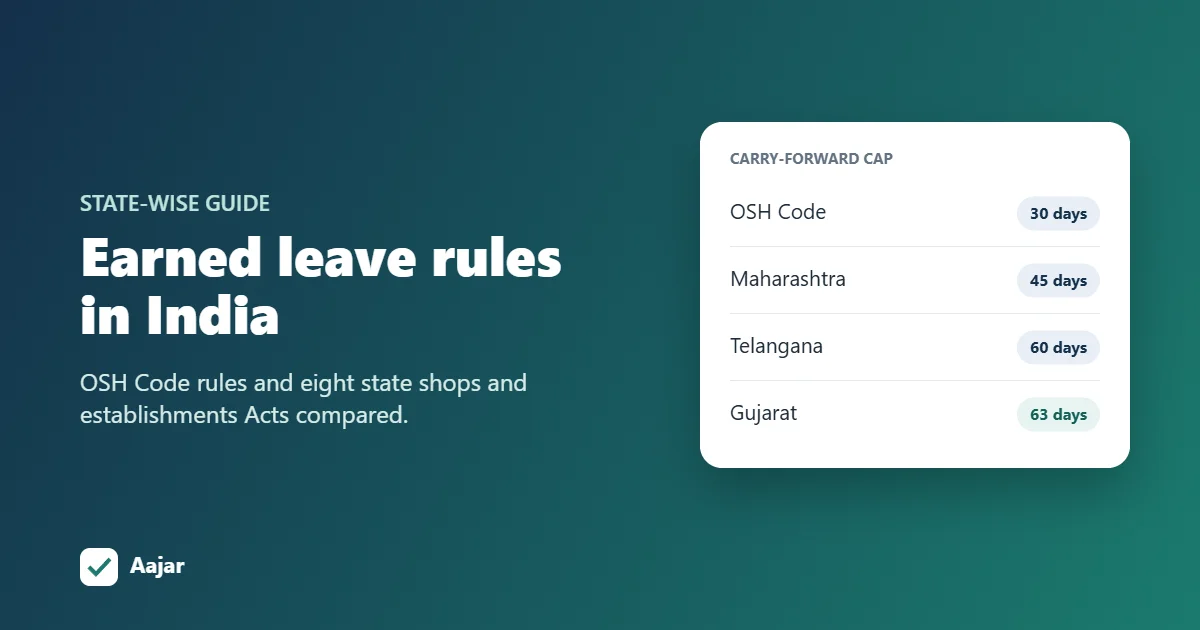
Earned Leave Rules in India: State-wise Guide (2026)
Earned leave under the OSH Code and the shops and establishments Acts of eight states, with carry-forward caps, encashment and worked examples.
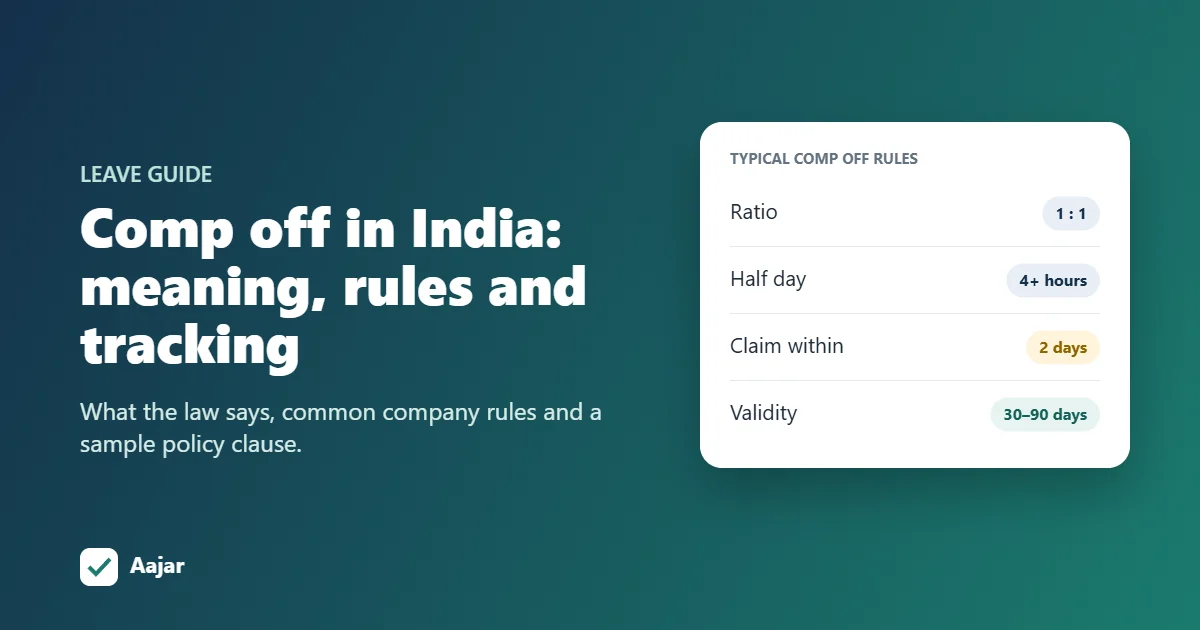
Comp Off in India: Meaning, Rules and How to Track It
What comp off means, what the OSH Code and state shops acts say, the rules most Indian companies use, and how to track comp off balances.
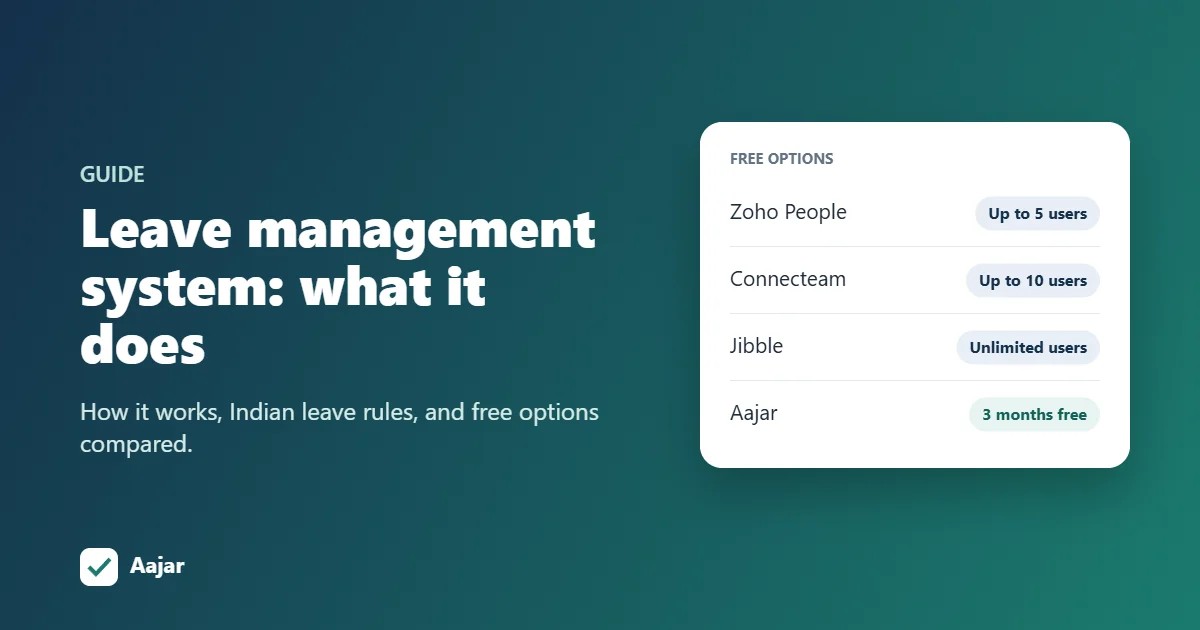
Leave Management System: What It Does and Free Options
What a leave management system does, the Indian leave rules it should handle, and free leave management options compared for small businesses.