Shift Timing in India: General Shift, Industry Timings and Legal Limits
Common shift timings in India by industry, general shift meaning, a 9:30-6:30 hours example and the OSH Code limits to check.
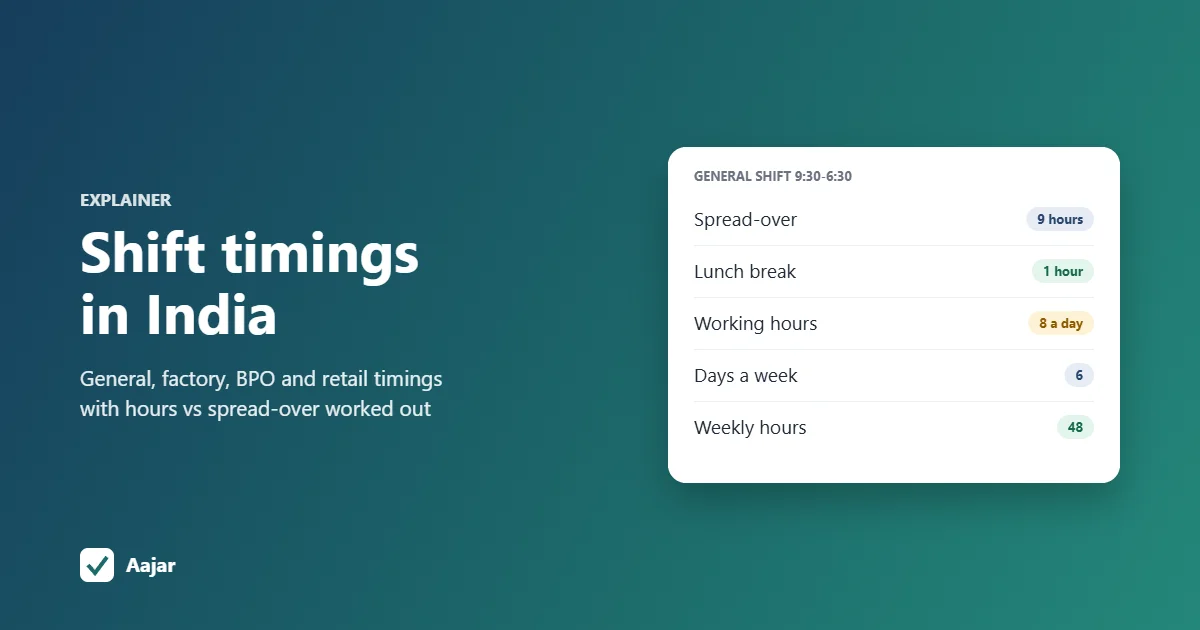
Short answer: shift timing is the fixed start and end time an employee works each day, such as 9:30 a.m. to 6:30 p.m. In India, a general shift usually runs about 9 hours with a 1-hour lunch break, which gives 8 working hours. Factories often run three 8-hour shifts (A, B and C, for example 6 a.m.–2 p.m., 2 p.m.–10 p.m. and 10 p.m.–6 a.m.). Under the OSH Code, normal working hours are up to 8 a day and 48 a week, and anything beyond that is overtime paid at twice the normal wage.
This guide explains what general shift timing means, lists common shift timings by industry, works through the hours in a 9:30–6:30 shift, and covers the legal points to check before you fix your timings.
What is shift timing?
Shift timing is the period an employer fixes for a group of employees to start and finish work. It has three parts: the start time, the end time and the breaks in between. A company can have one shift for everyone or several shifts that together cover a longer working day.
Two numbers come out of every shift timing, and it helps to keep them apart:
- Working hours: the time actually worked, without breaks. This is what the 8-hours-a-day limit applies to.
- Spread-over: the total time from the start of the shift to the end, including breaks. A 9:30 a.m. to 6:30 p.m. shift has a spread-over of 9 hours.
What is general shift timing?
The general shift is the regular daytime shift that office, admin and support staff work, usually with Sunday (and sometimes Saturday) off. In job ads it often appears as "general shift" or "G shift" to tell candidates there is no night or rotational work.
Common general shift timings in India are 9:00 a.m.–6:00 p.m., 9:30 a.m.–6:30 p.m. and 10:00 a.m.–7:00 p.m., each with a lunch break of 30 minutes to 1 hour. In a factory, the general shift is the day shift worked by staff such as maintenance, stores, accounts and the time office, alongside the production shifts.
What are 1st, 2nd and 3rd shift?
When a workplace runs round the clock in three 8-hour shifts, they are called the 1st, 2nd and 3rd shift, or in Indian factories the A, B and C shift.
| Shift | Also called | Typical timing |
|---|---|---|
| 1st shift | A shift, morning shift | 6:00 a.m. – 2:00 p.m. |
| 2nd shift | B shift, evening or second shift | 2:00 p.m. – 10:00 p.m. |
| 3rd shift | C shift, night shift | 10:00 p.m. – 6:00 a.m. |
Some plants start at 7:00 a.m. instead (7–3, 3–11, 11–7). The meal break is usually taken inside the 8 hours, so working hours per shift come to a little under 8.
Common shift timings in India by industry
The table below shows typical timings seen in Indian job ads and company policies. They are examples, not rules: your own timings depend on your work, your customers and the rules that apply to your establishment.
| Industry | Typical shift timing | Spread-over | Notes |
|---|---|---|---|
| Offices, IT, admin (general shift) | 9:30 a.m. – 6:30 p.m. | 9 h | 1-hour lunch; 5 or 6 days a week |
| Factory (three shifts) | 6–2, 2–10, 10–6 | 8 h each | Short meal break inside the shift; general shift for support staff |
| BPO, US process | 6:30 p.m. – 3:30 a.m. or 7:30 p.m. – 4:30 a.m. | 9 h | Matches 9 a.m.–6 p.m. US Eastern time; moves by an hour when US daylight saving starts or ends |
| BPO, UK process | 1:30 p.m. – 10:30 p.m. or 2:30 p.m. – 11:30 p.m. | 9 h | Matches 9 a.m.–6 p.m. UK time; changes with UK summer time |
| Retail stores | 10 a.m. – 7 p.m. and 1 p.m. – 10 p.m. | 9 h each | Two overlapping shifts cover a 12-hour store day, with most staff on the floor at the evening peak |
| Hospitals, nursing homes | 8 a.m. – 2 p.m., 2 p.m. – 8 p.m., 8 p.m. – 8 a.m. | 6 h, 6 h, 12 h | Many also use three 8-hour shifts; nights are usually rotated |
| Restaurants (split shift) | 11 a.m. – 3 p.m. and 6 p.m. – 10 p.m. | 11 h | 8 working hours but a long spread-over; check your state's limit |
| Security agencies | 8 a.m. – 8 p.m. and 8 p.m. – 8 a.m. | 12 h | 12-hour shifts go beyond 8 hours a day; see the legal section |
The BPO timings are worked out from time differences: India (IST) is 9 hours 30 minutes ahead of US Eastern time during US daylight saving and 10 hours 30 minutes ahead the rest of the year. That is why a US-process shift starts at 6:30 p.m. IST for part of the year and 7:30 p.m. for the rest.
Fixed, rotational and split shifts: what is the difference?
| Type | How it works | Where it is common |
|---|---|---|
| Fixed shift | The same timing every day, e.g. always the general shift | Offices, shops, most small businesses |
| Rotational shift | Teams move between morning, evening and night shifts, often weekly | Factories, BPOs, hospitals, security |
| Split shift | The working day is split into two parts with a long gap in between | Restaurants, catering, some retail |
What are the legal limits on shift timing in India?
The Occupational Safety, Health and Working Conditions Code, 2020 has been in force since 21 November 2025 (India Code: OSH Code, 2020). The Government's factsheet on the Code sums up the hours rules (PIB factsheet on the OSH Code):
| Rule | What it means for your shift timings |
|---|---|
| Up to 8 hours a day and 48 hours a week | A shift with 8 working hours, 6 days a week, is the standard pattern. |
| 4-day week of 12 hours, 5-day week of 9.5 hours or 6-day week of 8 hours, without overtime | A longer daily shift is possible if the number of working days is reduced to match. |
| Overtime needs the worker's consent and is paid at twice the normal wage | Any work beyond the normal hours must be agreed and paid at double rate. Record it. |
| Women may work night shifts (before 6 a.m. and after 7 p.m.) with their consent | The employer must arrange safety, facilities and transport for them. |
| Rest intervals and spread-over are fixed by the appropriate government | The maximum spread-over and the break you must give after a stretch of work are set by the rules that apply to you. |
For establishments where the Central Government is the appropriate government, the detailed rules are in the OSH (Central) Rules, 2026, notified on 8 May 2026. Most private shops, offices and factories come under their state government, and state rules differ, so check your state labour department's rules for the spread-over and rest-interval limits before you fix a long or split shift. Sources checked on 21 October 2026.
Worked example: hours vs spread-over in a 9:30–6:30 shift
Take a 25-person office in Pune that runs a 9:30 a.m. to 6:30 p.m. general shift with a lunch break from 1:30 to 2:30 p.m., six days a week.
| Item | Hours | Working |
|---|---|---|
| Spread-over | 9 | 9:30 a.m. to 6:30 p.m. |
| Lunch break | 1 | 1:30 to 2:30 p.m. |
| Working hours a day | 8 | 9 − 1 |
| Longest stretch without a break | 4 | 9:30 to 1:30, and again 2:30 to 6:30 |
| Working hours a week | 48 | 8 × 6 days |
This shift sits exactly at the 8-hour and 48-hour limits, so there is no room for regular late sitting without overtime. If an employee stays until 8:00 p.m. one day, they work 9.5 hours that day: 1.5 hours of overtime that needs their consent and is paid at twice the normal rate. Our guide on how to calculate overtime pay shows the calculation in rupees.
Now suppose the same office moves to a 5-day week with Saturday off and the timing changes to 9:30 a.m. to 7:00 p.m. Working hours become 8.5 a day (9.5 − 1) and 42.5 a week (8.5 × 5). That is within the 5-day option of up to 9.5 hours a day in the PIB factsheet and within 48 hours a week, so it is not overtime. Check your state's rules too, since some states have their own limits for shops and establishments.
Is a 9-hour shift legal in India?
Usually yes, if you read it correctly. Most "9-hour shifts" in India, such as 9 to 6 or 9:30 to 6:30, include a 1-hour lunch break, so the actual working time is 8 hours, which is within the daily limit.
Nine hours of actual work a day is different. On a 6-day week, the hour beyond 8 is overtime, which needs the worker's consent and double pay. On a 5-day week, the OSH Code allows up to 9.5 hours a day without overtime, as long as the weekly total stays within 48 hours. The spread-over must also stay within the limit in your state's rules.
How to set shift timings for your business
- Start from your work hours. List when customers, machines or clients need people, and how many at each hour.
- Choose the number of working days. 6 days of 8 hours, 5 days of up to 9.5 hours, or 4 days of up to 12 hours, keeping within 48 hours a week.
- Fix breaks. Place the meal break so no stretch of work is too long, and check the interval rule that applies to you.
- Check spread-over. Especially for split shifts, make sure start-to-finish time is within your state's limit.
- Set late and half-day rules. For example, a 10-minute grace after 9:30 and a half day if someone works less than 4 hours. Write them in your leave and attendance policy.
- Plan night shifts carefully. Get written consent from women employees working before 6 a.m. or after 7 p.m. and arrange transport.
- Publish the timings and keep attendance records against them, so overtime and late marks can be worked out from the punches. Our guide to the time office explains the records to keep.
Managing shift timings on Aajar
On every Aajar plan, including Starter at ₹20 per user per month, you can set late grace, half-day and full-day rules and weekly offs, so a 9:31 check-in on a 9:30 general shift is handled the way your policy says. Shifts, where you set more than one shift timing, along with overtime and comp-off requests, are on Growth at ₹35 per user per month.
You decide who works which shift; Aajar then applies your rules to each check-in. If you run night shifts that cross midnight, test how check-ins are recorded during the free trial: every plan is free for the first 3 months for organisations with up to 50 users. See Aajar pricing.
Frequently asked questions
What is shift timing?
Shift timing is the fixed start and end time of an employee's working day, along with the breaks in between. For example, a general shift of 9:30 a.m. to 6:30 p.m. with a 1-hour lunch break.
What is 1st, second and 3rd shift?
They are the three 8-hour shifts of a round-the-clock workplace: 1st (morning, e.g. 6 a.m.–2 p.m.), 2nd (evening, 2 p.m.–10 p.m.) and 3rd (night, 10 p.m.–6 a.m.). Indian factories often call them the A, B and C shifts.
What is a normal shift time?
In Indian offices, a normal or general shift is about 9 hours, such as 9:30 a.m. to 6:30 p.m., including a 1-hour lunch break. That gives 8 working hours, the normal daily limit under the OSH Code.
Is a 9 hour shift legal?
A 9-hour shift with a 1-hour break is 8 working hours, which is within the limit. Nine hours of actual work is overtime on a 6-day week, but can be allowed without overtime on a 5-day week of up to 9.5 hours a day, as long as the week stays within 48 hours.
What is spread-over in a shift?
Spread-over is the total time from the start to the end of a working day, including breaks. Its maximum is set by the central or state rules that apply to your establishment.
Can women work night shifts in India?
Yes. Under the OSH Code, women can work before 6 a.m. and after 7 p.m. with their consent, and the employer must arrange safety, facilities and transport.
This article is general information, not legal advice.
Keep reading
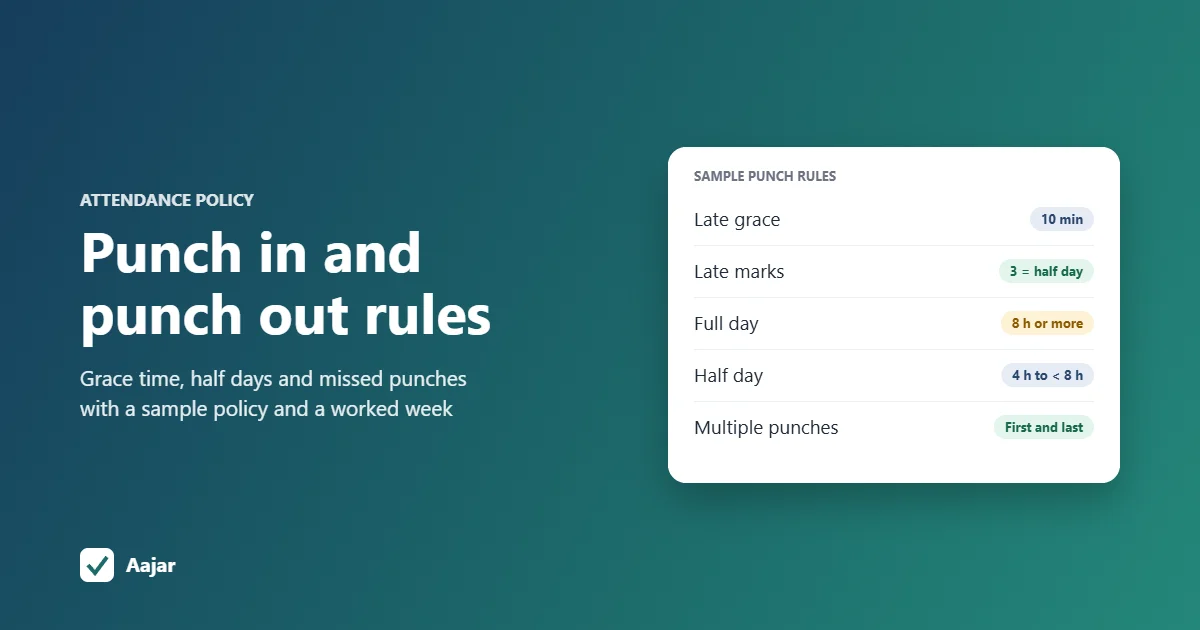
Punch In and Punch Out: Rules Every Small Business Should Set
What punch in and punch out mean, and the grace time, half-day, missed punch and overtime rules a small business should write down.
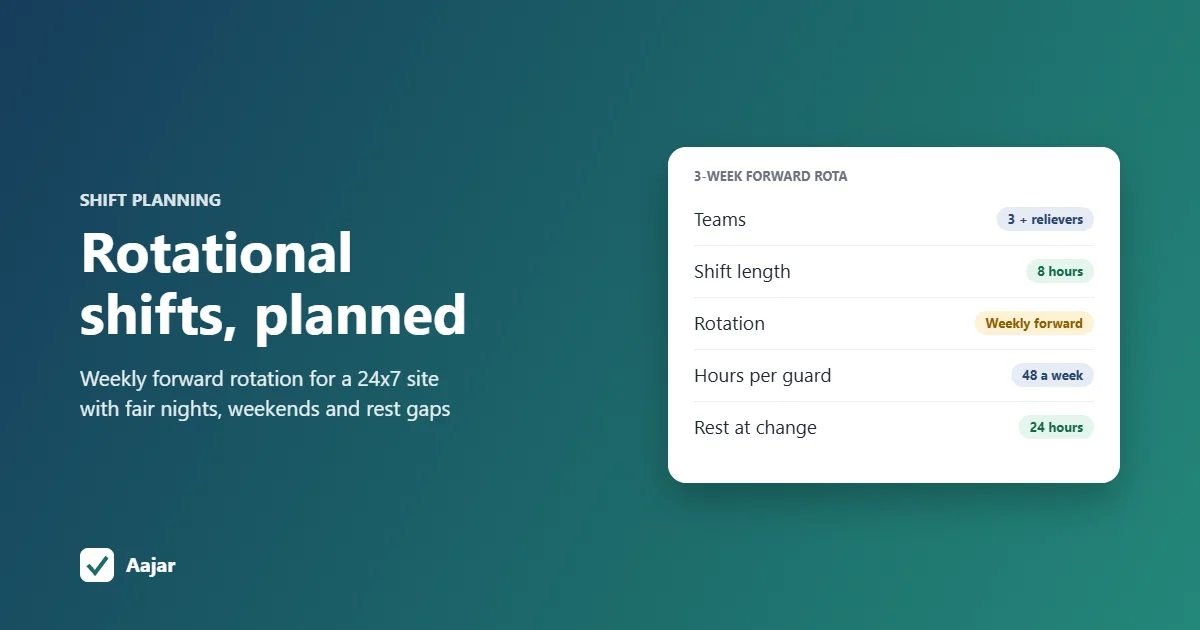
Rotational Shift: Patterns, Fair Planning and a 24x7 Example
Rotation patterns compared, a fair-planning checklist and a 3-week roster for a 24x7 site that stays within 48 hours a week.
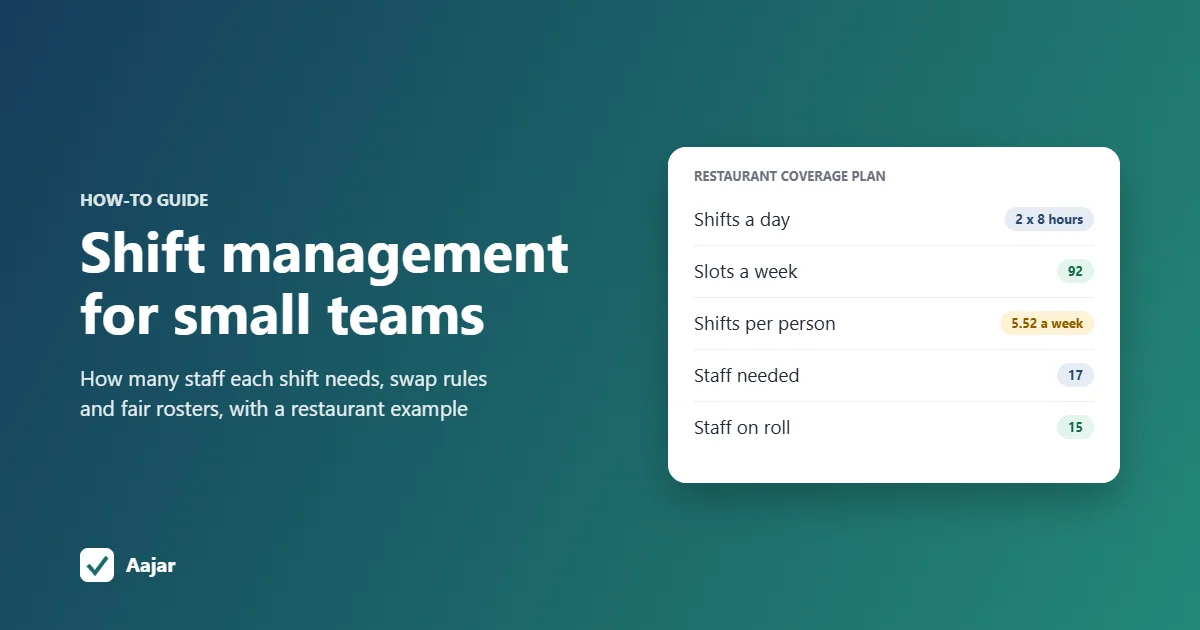
Shift Management for Small Teams: Coverage, Swaps and Fairness
How many staff each shift needs, worked through for a 15-person restaurant, plus shift swap rules and ways to keep rosters fair.