Punch In and Punch Out: Rules Every Small Business Should Set
What punch in and punch out mean, and the grace time, half-day, missed punch and overtime rules a small business should write down.
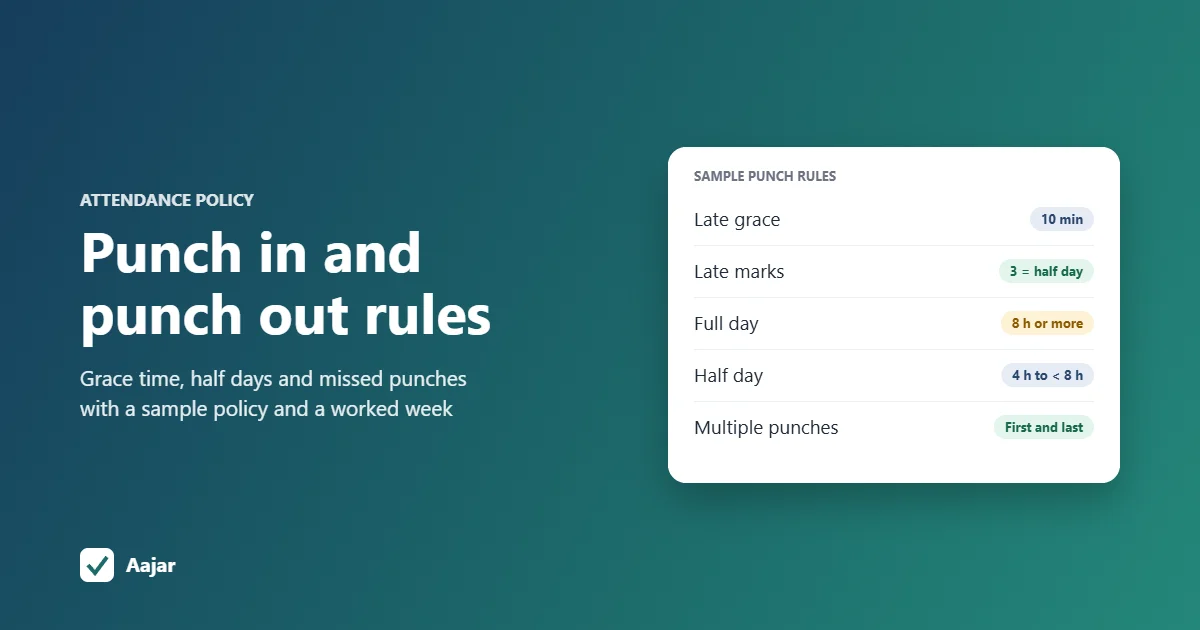
Short answer: to punch in means to record the time you start work, and to punch out means to record the time you finish, on a biometric machine, a phone app or a register. The punch in punch out times decide whether a day counts as present, late, half day or absent, so every business needs written rules for them. A simple small-business setup is a 10-minute grace for late punch-in, 3 late marks in a month = half day, a full day at 8 hours between first and last punch, and a half day at 4 hours.
This guide explains what punch in and punch out mean, the rules to set, a sample punch rules policy you can copy, and a worked week of punches for a demo employee.
What does punch in and punch out mean?
The terms come from the old time clock, where a worker pushed a paper card into a machine that "punched" the time on it. Today the punch is a fingerprint or face scan on a biometric machine, a tap in a phone app, or a QR scan at the office door.
| Term | Meaning |
|---|---|
| Punch in (clock in) | Recording the time you arrive and start work |
| Punch out (clock out) | Recording the time you stop work and leave |
| Missed punch | A day with an in-punch but no out-punch, or the reverse |
| Punch time | The time between the first punch-in and the last punch-out of the day |
A punch on its own is just a time stamp. What turns it into "present", "late" or "half day" is the set of rules your business applies to it.
Why does a small business need punch in punch out rules?
Without written rules, each manager decides on the spot whether 9:42 is late or whether a missing punch-out is a full day. That leads to arguments at salary time and to payroll mistakes that are hard to undo.
Clear rules also make attendance software useful. A machine or app can only calculate late marks and half days if you tell it where the lines are.
What punch rules should you set?
How much grace time should you allow for late punch-in?
A grace of 5 to 15 minutes after shift start, before a punch counts as late, is a reasonable range. Ten minutes is a sensible default: it covers a delayed bus or a queue at the machine without making the start time meaningless.
Decide what late marks lead to. One simple rule is 3 late marks in a calendar month = half a day deducted, first from the employee's leave balance and then as loss of pay. Write the rule down and share it with staff before you apply it.
When is a day a full day, a half day or absent?
Base this on hours between the first punch-in and the last punch-out. For a 9-hour shift with a 1-hour lunch, a full day at 8 hours or more and a half day at 4 hours to under 8 hours works well. Under 4 hours, or no punch at all without approved leave, is absent.
What happens when someone forgets to punch out?
Missed punch-outs cause more month-end corrections than almost anything else. Treat them as a process, not a penalty:
- The day shows as "punch missing" in the attendance report.
- The employee tells the manager by the next working day, with the actual leaving time.
- The manager confirms, and HR corrects the day with a short note.
- If nobody fixes it by the month-end cut-off, the policy decides the outcome (for example, a half day).
Reminders cut the number of missed punches. So does placing the machine near the exit rather than in a back office.
How should multiple punches in a day be counted?
People punch more than twice: at lunch, when stepping out, or because the machine didn't beep the first time. The simplest rule is "first in, last out": the earliest punch of the day is the punch-in, the latest is the punch-out, and everything in between is ignored for the daily total.
Don't rely on the IN and OUT buttons on biometric machines. Staff press the wrong one all the time, and first-in/last-out logic doesn't need them.
Do employees need to punch for breaks?
For most small businesses, no. Fix the lunch and tea breaks in the policy (for example, 1 hour for lunch inside a 9-hour shift) and count the whole span from first to last punch.
Break punching makes sense only when long or frequent breaks are a real problem, such as on a production line. If you do it, you need software that tracks in/out pairs and a rule for the maximum break, and expect more missed punches.
How should early leaving be handled?
Set a grace for leaving too, for example a punch-out up to 10 minutes before shift end is fine. Leaving earlier without approved permission counts as an early mark, and early marks can be added to late marks for the 3-marks rule. If the hours fall below the full-day threshold, the half-day rule applies instead.
When does overtime start?
Under the OSH Code, normal working hours are up to 8 a day and 48 a week, and overtime needs the worker's consent and is paid at twice the normal wage (PIB factsheet on the OSH Code, November 2025). In your punch rules, say that overtime is counted from the shift end time and only when a manager approved it in advance. Our guide on how to calculate overtime pay shows the working.
How do you handle night shifts that cross midnight?
A shift from 10 pm to 6 am has its punch-in on one date and its punch-out on the next. The usual rule is that the whole shift belongs to the date of the punch-in, so the employee gets one full day, not two half days.
Paper and Excel handle this by hand. If you use software, check that it can tie a next-morning punch-out to the previous night's shift before you rely on it.
What about field staff who never see the machine?
Sales staff, technicians and site supervisors can't punch at the office. Let them punch in and out from a phone, ideally with location recorded or a geofence around the site. Our guide to GPS and geofence attendance for field staff covers the options.
A sample punch rules policy
Here is a policy for a demo 25-person retail chain with a 9:30 am to 6:30 pm shift, Monday to Saturday, and a 1-hour lunch. Change the numbers to suit your business.
| Rule | Policy |
|---|---|
| Shift | 9:30 am to 6:30 pm, 1 hour lunch, Sunday off |
| Late grace | Punch-in up to 9:40 am is on time; after that it is a late mark |
| Late marks | 3 late or early marks in a calendar month = half day deducted (from leave balance first, then loss of pay) |
| Full day | 8 hours or more between first punch-in and last punch-out |
| Half day | 4 hours to under 8 hours |
| Absent | Under 4 hours, or no punch without approved leave |
| Early leaving | Punch-out before 6:20 pm without permission = early mark |
| Missed punch | Report by next working day; HR corrects after manager confirms; unresolved at cut-off = half day |
| Multiple punches | First punch = in, last punch = out; punches in between ignored |
| Breaks | No break punching; lunch is inside the shift |
| Overtime | Counted from 6:30 pm, only with prior manager approval and the employee's consent |
| Night shifts | Whole shift belongs to the date of punch-in |
| Field staff | Punch from phone at first and last visit of the day |
Worked example: one week of punches
Ravi is a demo store executive on the policy above. He earns ₹15,500 a month gross, has casual leave available, and already had one late mark earlier in October 2026. Here are his punches for the week of 19 to 24 October 2026.
| Day | Punches recorded | First in / last out | Hours | Result |
|---|---|---|---|---|
| Mon 19 Oct | 9:36, 13:32, 14:25, 18:41 | 9:36 / 18:41 | 9 h 05 m | Full day, on time (within grace) |
| Tue 20 Oct | 9:52, 18:35 | 9:52 / 18:35 | 8 h 43 m | Full day, late mark 2 |
| Wed 21 Oct | 9:47, 18:30 | 9:47 / 18:30 | 8 h 43 m | Full day, late mark 3: half day deducted |
| Thu 22 Oct | 9:31, 14:05 | 9:31 / 14:05 | 4 h 34 m | Half day (left without leave) |
| Fri 23 Oct | 9:28 | 9:28 / missing | None | Missed punch-out; corrected to 18:35 by HR: full day |
| Sat 24 Oct | 9:33, 20:00 | 9:33 / 20:00 | 10 h 27 m | Full day + 1 h 30 m approved overtime |
How each case is treated:
- Monday: four punches, but first-in/last-out gives one clean day. The lunch punches don't create an error.
- Wednesday: the third late mark of October triggers the half-day deduction. Ravi has casual leave, so half a day comes off his leave balance and his pay is unchanged.
- Thursday: 4 h 34 m is between 4 and 8 hours, so it is a half day. He didn't apply for leave, so half a day is loss of pay: ₹15,500 ÷ 31 days = ₹500 a day, so ₹250.
- Friday: Ravi reported the missed punch-out on Saturday morning, his manager confirmed he left at 6:35 pm, and HR corrected the day with a note.
- Saturday: he stayed for an approved stock count. Overtime runs from 6:30 pm to 8:00 pm, so 1 h 30 m goes to payroll as overtime.
Week result: 5.5 days present, ₹250 loss of pay, half a day of casual leave used for late marks, and 1.5 hours of overtime. This example uses calendar days as the salary base; some businesses divide by 26 or by working days, so pick one method and use it every month.
How do you track punches: register, Excel or app?
| Method | Works for | Watch out for |
|---|---|---|
| Paper register | Very small teams, one location | Times written later, proxy signing, manual totals |
| Excel sheet | Up to 10 to 15 people | Typing errors, formulas to maintain |
| Biometric machine | Factories, stores, offices with one entrance | Needs software to apply your rules |
| Phone app | Offices, field staff, multiple sites | Use location or a geofence to stop punching from home |
If you are starting small, our attendance sheet in Excel template has formulas for present, half day and absent. If you already have an eSSL or similar machine, see how to connect an eSSL biometric device to a cloud app so punches reach your rules automatically.
Setting punch rules on Aajar
On every Aajar plan, from Starter at ₹20 per user per month, employees check in and out from a phone or computer, and you set late grace, half-day and full-day rules and clock-in reminders. Late marks, half days and leave flow into the monthly attendance table and payroll, and HR can correct any day by hand. Shifts, geofenced check-in and overtime requests are on Growth (₹35).
With biometric device sync (Business, ₹50), the earliest punch of the day is the check-in and the latest is the check-out, so lunch punches and repeated scans don't cause errors. Aajar keeps one attendance record per person per day, so if you run night shifts, test how they show up during the free trial. Every plan is free for 3 months for organisations with up to 50 users; see Aajar pricing.
Frequently asked questions
What is punch in punch out?
It is the record of when an employee starts work (punch in) and finishes work (punch out), made on a biometric machine, app or register. The two times decide whether the day is full, half or absent.
What is punch in attendance?
Punch in attendance is a system where employees record their arrival time with a punch, such as a fingerprint scan or an app tap, instead of signing a register. The software then applies late, half-day and full-day rules.
What does "punch in" mean?
To punch in is to record the time you arrive at work. The phrase comes from time clocks that punched the time onto a paper card.
What does "punch out" mean?
To punch out is to record the time you finish work and leave. In attendance, a missing punch-out usually needs a manager's confirmation before the day is counted.
How many minutes late is acceptable for punch-in?
There is no fixed rule; it is your company policy. A grace of 5 to 15 minutes is a reasonable range, and 10 minutes is a sensible default.
What happens if I forget to punch out?
The day shows a missing punch. Tell your manager the actual leaving time quickly so HR can correct it before the month-end cut-off.
This article is general information, not legal advice.
Keep reading
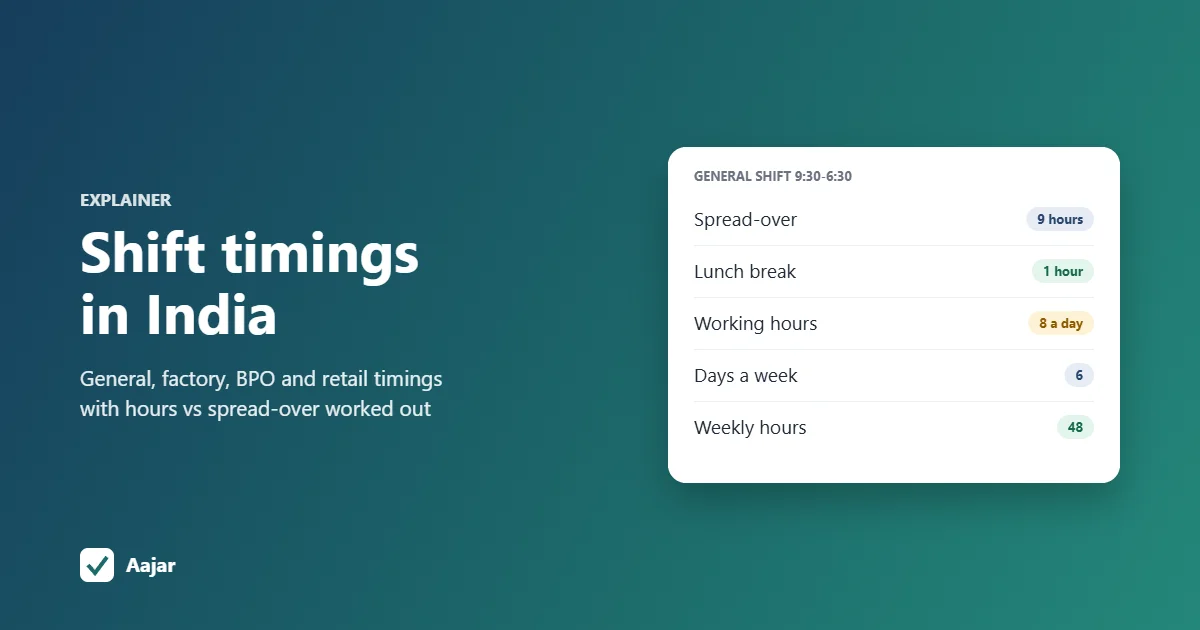
Shift Timing in India: General Shift, Industry Timings and Legal Limits
Common shift timings in India by industry, general shift meaning, a 9:30-6:30 hours example and the OSH Code limits to check.
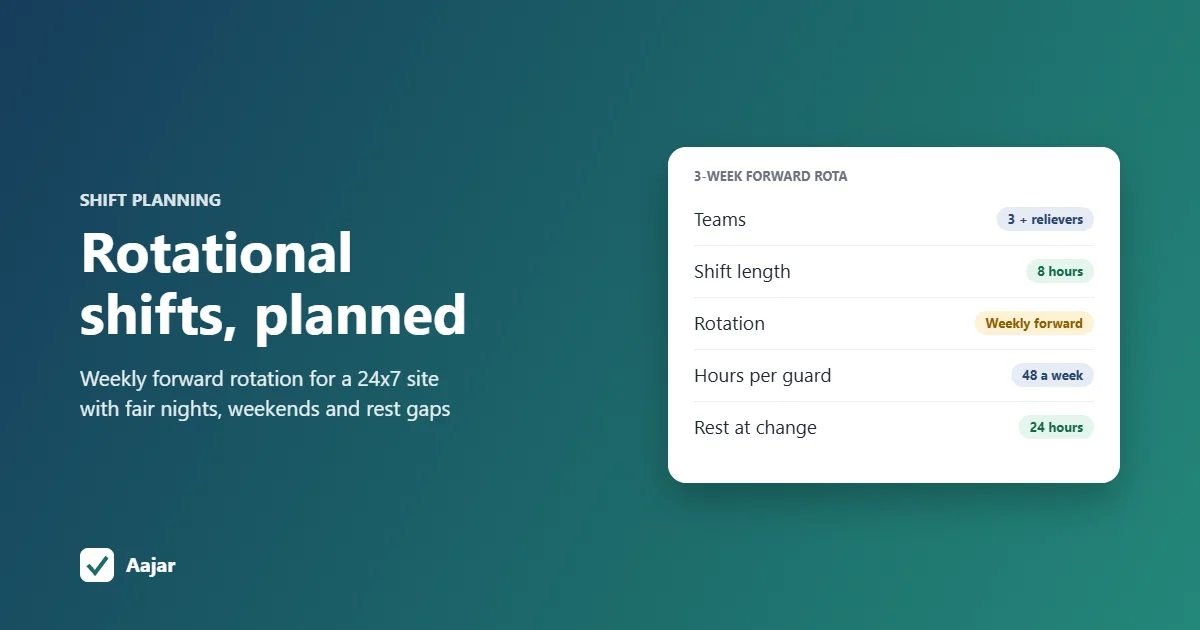
Rotational Shift: Patterns, Fair Planning and a 24x7 Example
Rotation patterns compared, a fair-planning checklist and a 3-week roster for a 24x7 site that stays within 48 hours a week.
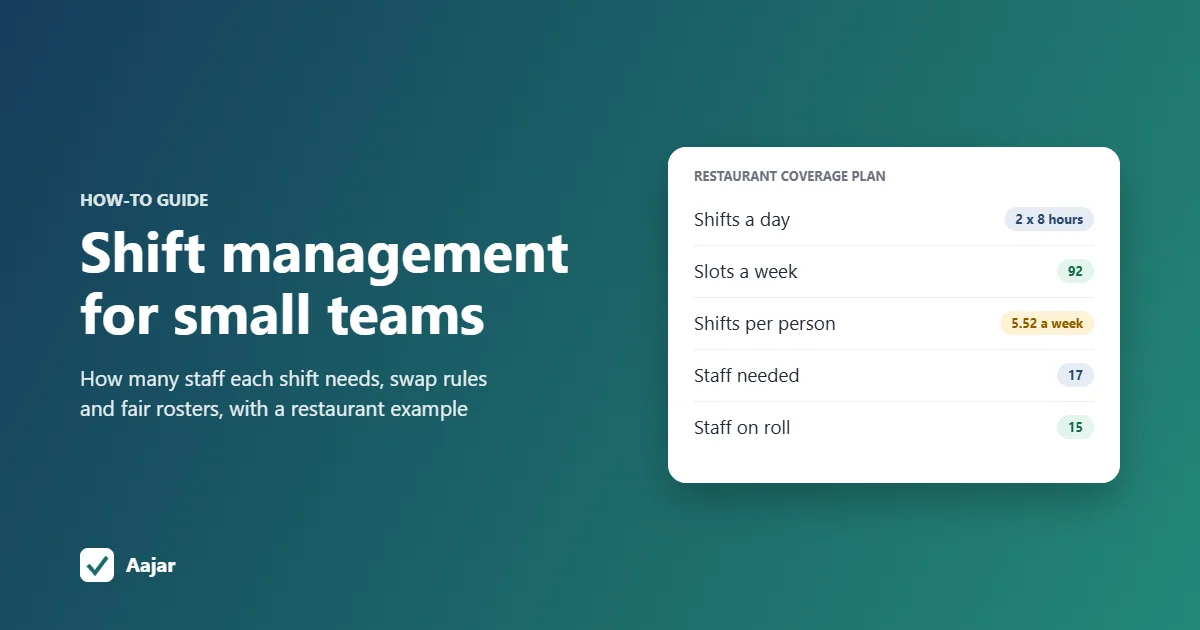
Shift Management for Small Teams: Coverage, Swaps and Fairness
How many staff each shift needs, worked through for a 15-person restaurant, plus shift swap rules and ways to keep rosters fair.