Muster Roll: Format, Legal Rules and Going Digital
What a muster roll is, the new Form IX under the Wages (Central) Rules 2026, what to record, penalties, and how to keep it digitally.
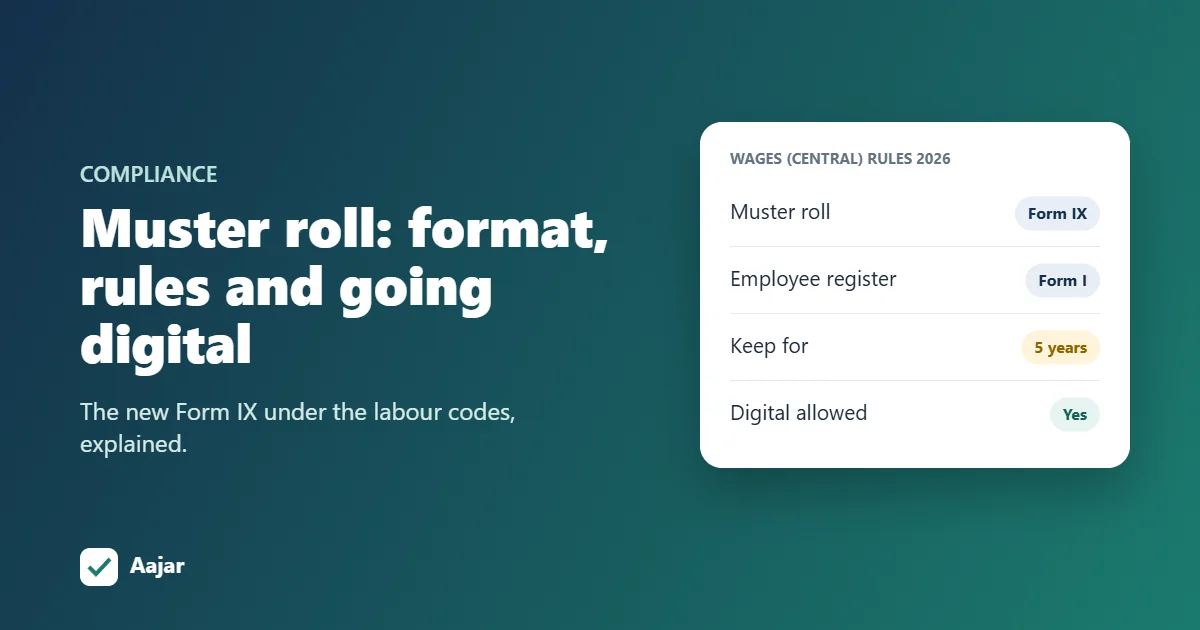
Short answer: a muster roll is the register of daily attendance an employer must keep for its employees. Under the Code on Wages, 2019 and the Wages (Central) Rules, 2026, it is kept in Form IX, the Attendance Register-cum-Muster Roll, alongside the employee register (Form I) and the wages register (Form IV). It can be kept electronically or on paper and must be preserved for five years. Not keeping it properly can lead to a fine of up to ₹10,000, after an inspector first gives you a chance to comply.
This guide explains what a muster roll is, which forms replaced the old ones, what to record, and how to keep it digitally.
What is a muster roll?
A muster roll is the statutory name for an attendance register: a day-by-day record of who was present at the workplace, kept for a month at a time. The word comes from "mustering" workers for a roll call. Labour inspectors use it to check attendance against wages, overtime and leave.
In everyday HR use, the terms muster roll, attendance register and attendance sheet often mean the same thing. Legally, the muster roll is the version in the format your rules prescribe.
Muster roll under the new labour codes
The labour codes came into force on 21 November 2025, and the central rules under them were notified on 8 May 2026. They replace the muster roll formats of older laws.
Code on Wages, 2019
Section 50(1) requires every employer to keep a register of persons employed, a muster roll, wages and other details as prescribed. Employers of up to five people in agriculture or domestic work are exempt (s.50(4)) (TaxClue).
Wages (Central) Rules, 2026
Rule 51 prescribes three registers (TaxClue; BDO):
| Form | Register | What it records |
|---|---|---|
| Form I | Employee Register | Details of each person employed |
| Form IV | Register of Wages, Overtime, Advances, Fines and Deductions for Damage and Loss | Pay, overtime and deductions |
| Form IX | Attendance Register-cum-Muster Roll | Daily attendance, days worked, overtime and work done away from the workplace |
- Registers can be kept electronically or in physical form.
- They must be preserved for five years after the last entry (Rule 51(4)).
- Forms IV and IX need signatures only if they are kept on paper.
- Wage slips are issued in Form V (Rule 52), electronically or on paper.
OSH (Central) Rules, 2026
The OSH rules also prescribe registers: Form XIII (employees), Form XIV (attendance register-cum-muster roll) and Form XV (wages, overtime and deductions), kept electronically or on paper for five years. Registers already kept under the Wages Rules count as kept under the OSH Rules, so one attendance register can serve both (iPleaders).
State rules
The forms above are from the central rules, which apply to establishments under the central government's jurisdiction. States notify their own rules with their own form numbers. For example, Rajasthan's OSH rules use Form-17 for the attendance-cum-muster roll (Lexplosion). Check which rules apply to your establishment.
Old muster roll forms, now replaced
| Old law | Muster roll form | Status |
|---|---|---|
| Minimum Wages (Central) Rules, 1950 | Form V, under Rule 26(5) | Replaced by the Code on Wages |
| Contract Labour (Regulation and Abolition) Central Rules, 1971 | Form XVI, kept by each contractor | Replaced by the OSH Code |
| Factories Act, 1948 | Register of adult workers under s.62, in a form set by state rules (for example Karnataka's Form 22) | Replaced by the OSH Code |
If you still use pre-printed Form V or Form XVI registers, plan to move to the new formats as your state's rules come into force.
What to record in a muster roll
The official Form IX layout is set in the gazette, so use the prescribed format for inspections. In practice, a muster roll usually has these columns:
| Column | Example |
|---|---|
| Employee code | EMP-014 |
| Name | Ravi Kumar |
| Designation and department | Machine operator, Production |
| Shift | General (9:00 to 6:00) |
| Days 1 to 31 | P, A, HD, WO, H, CL, SL, EL, CO |
| Total days present | 24 |
| Overtime hours | 6 |
| Days on tour or work outside the workplace | 2 |
Typical columns, based on templates such as CalcGuru's Form IX template. Not the official gazette layout.
The codes are the same ones most companies use on attendance sheets: P for present, A for absent, HD for half day, WO for weekly off, H for holiday, CL, SL and EL for leave, and CO for comp off. Our attendance sheet in Excel guide shows how to total them with formulas.
Penalty for not keeping a muster roll
Under Section 54(2) of the Code on Wages, not keeping records, or keeping them improperly, can be punished with a fine of up to ₹10,000. Under Section 54(3), the inspector must first give a written direction to comply, and if you comply in time there is no prosecution. That chance isn't given for a repeat offence within five years (Code on Wages, s.54).
Paper vs digital muster roll
| Paper register | Digital muster roll | |
|---|---|---|
| Allowed under the new rules | Yes, with signatures | Yes |
| Marking attendance | Supervisor writes it daily | Employees check in by phone, computer or biometric device |
| Totals and overtime | Counted by hand | Calculated automatically |
| Five-year retention | Bound registers stored on site | Kept in the system; export when needed |
| Link to payroll | Copied across each month | Days present and leave flow into salary |
| Risk | Lost or damaged registers, back-filled entries | Depends on the system's records and backups |
How to keep a digital muster roll
- Choose how people mark attendance: a phone app, a web check-in or a biometric device.
- Set your rules: shift times, weekly offs, holidays and leave types, so each day gets the right code.
- Record overtime and on-duty days through approvals rather than notes.
- Review the monthly table before payroll and correct any errors with a note.
- Export and store each month's register so you can produce it for an inspector within five years.
Muster roll in Aajar
Aajar builds the monthly attendance table from check-ins, approved leave, holidays, weekly offs and on-duty requests, and admins can export it to Excel. Each day shows as present, half day, leave, holiday, weekly off or absent, and the same figures feed loss of pay in payroll. Overtime requests (Growth plan; see how to calculate overtime) and eSSL biometric sync (Business plan) add overtime hours and device punches to the record. Aajar's export is an attendance report, not a pre-filled Form IX, so map its columns to your state's prescribed format. See pricing.
Frequently asked questions
What is the muster roll form under the Code on Wages?
Form IX, the Attendance Register-cum-Muster Roll, under Rule 51 of the Wages (Central) Rules, 2026. State rules may use different form numbers.
Can a muster roll be kept electronically?
Yes. Both the Wages (Central) Rules and the OSH (Central) Rules allow registers to be kept electronically or on paper.
How long must a muster roll be kept?
Five years from the last entry, under the central rules.
Is a muster roll the same as an attendance register?
Broadly, yes. Under the new central rules, the two are combined into one attendance register-cum-muster roll.
Who must keep a muster roll?
Every employer covered by the Code on Wages, except employers of up to five people in agriculture or domestic work. Contractors keep registers for the workers they supply.
This article is general information, not legal advice. Form numbers and formats depend on whether central or state rules apply to you.
Keep reading
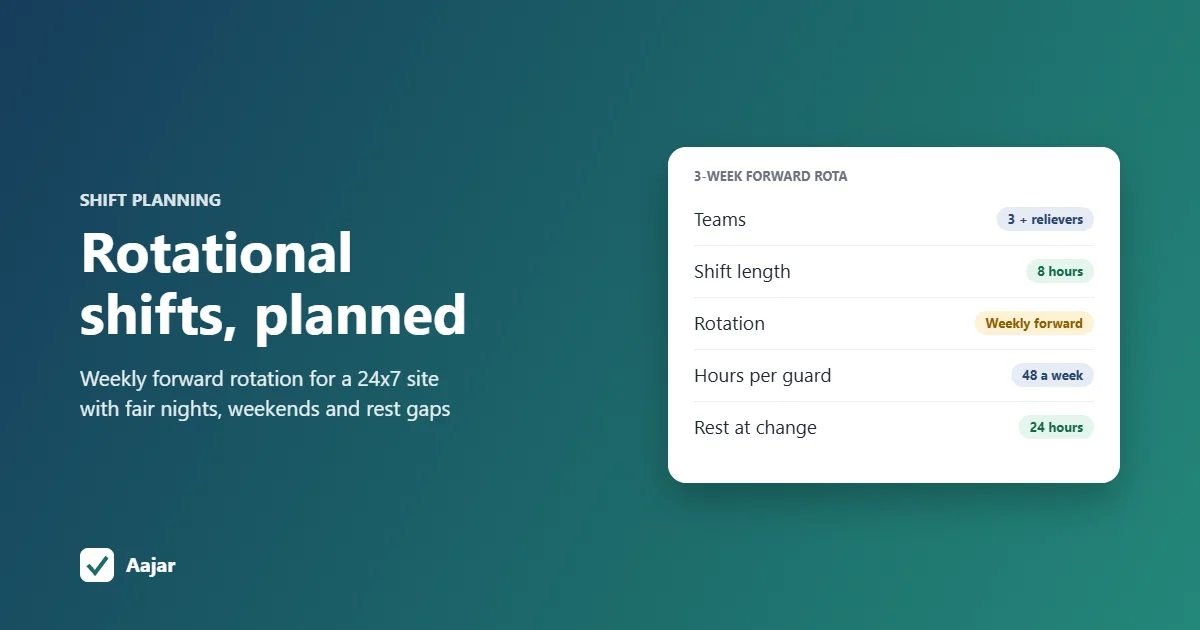
Rotational Shift: Patterns, Fair Planning and a 24x7 Example
Rotation patterns compared, a fair-planning checklist and a 3-week roster for a 24x7 site that stays within 48 hours a week.
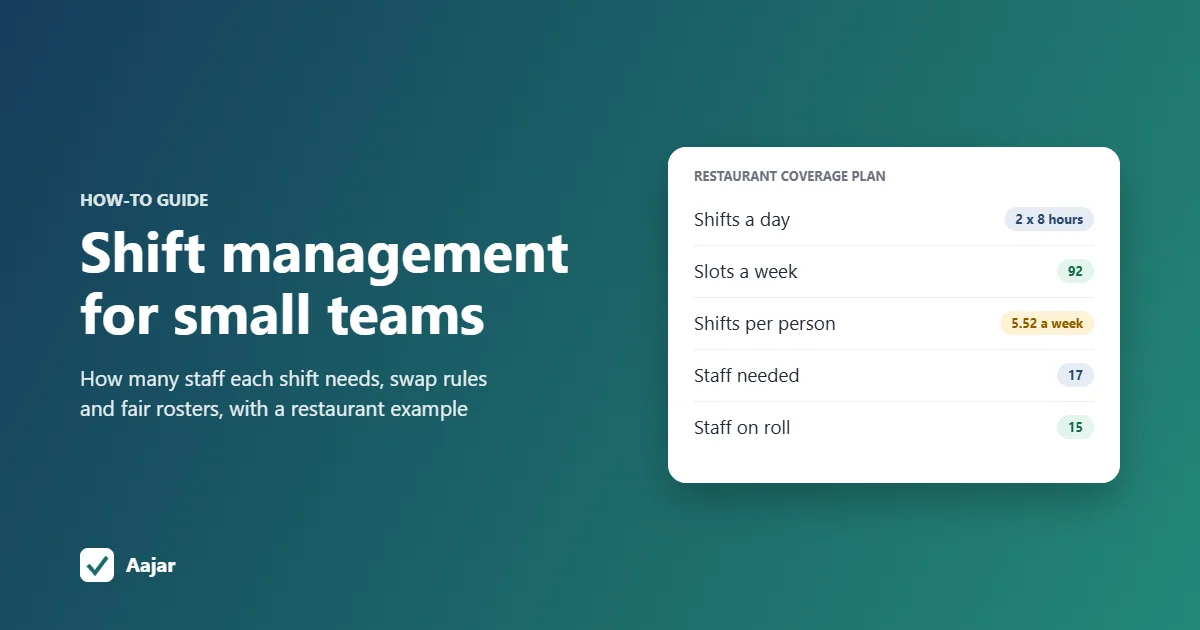
Shift Management for Small Teams: Coverage, Swaps and Fairness
How many staff each shift needs, worked through for a 15-person restaurant, plus shift swap rules and ways to keep rosters fair.
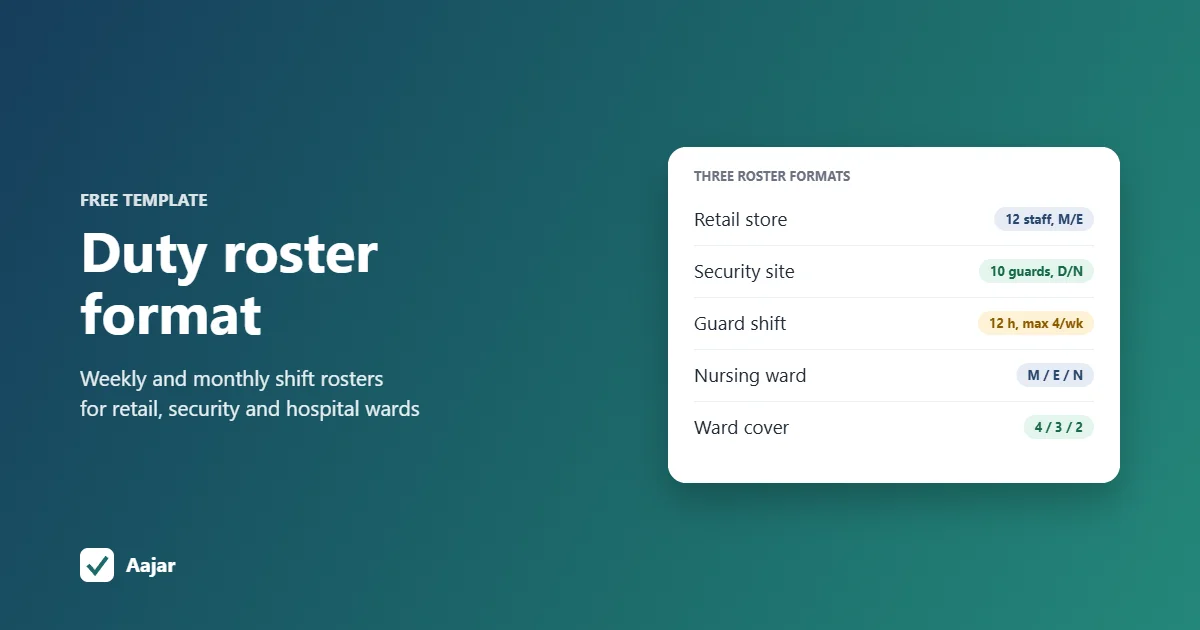
Duty Roster Format: Free Shift Roster Templates for Retail, Security and Hospitals
Three ready duty roster formats for retail, security and hospital wards, plus shift codes and Excel steps to build your own.