Leave Without Pay (LWP): Rules, Salary and Benefits
When unpaid leave applies, how to approve it, how the salary deduction is worked out, and what LWP does to PF, ESI, earned leave and gratuity.
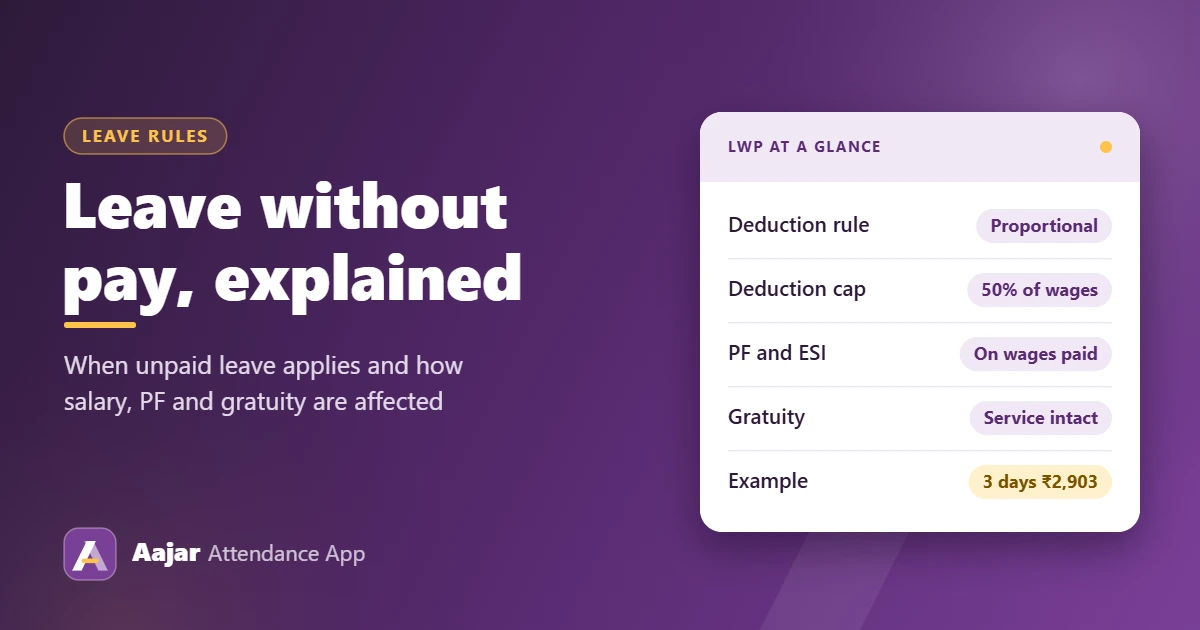
Short answer: Leave without pay (LWP), also called unpaid leave, is approved time off for which the employee gets no salary for those days. It usually applies when paid leave balances run out or when someone needs a longer break. The salary for LWP days is deducted in proportion to the absence, and PF and ESI contributions are worked out on the lower wages actually paid.
For a small company, LWP looks simple until it touches payroll, earned leave and gratuity. This guide explains when leave without pay applies, how to approve it, how the salary maths works, and what happens to an employee's benefits and service record.
What is leave without pay (LWP)?
Leave without pay is leave the employer has agreed to, but without wages for the days taken. The employee stays on the rolls, keeps their job and returns on an agreed date. Only the pay for those days stops.
People use several names for the same idea: LWP, unpaid leave, extraordinary leave (EOL) in government service, and leave without salary. In most private company policies they mean the same thing.
Is LWP the same as LOP (loss of pay)?
Not quite, although payslips often use the terms loosely. LWP is a leave type the employee asks for and a manager approves. LOP is the payroll result: the days for which salary is cut.
So approved LWP leads to LOP days on the payslip. But LOP can also come from absence without approval, late marks converted to half-days, or missing attendance that was never regularised. Keeping the two apart in your records helps when you later look at someone's service history.
| Point | Leave without pay (LWP) | Loss of pay (LOP) |
|---|---|---|
| What it is | A leave type that is requested and approved | The salary deduction for unpaid days |
| Who starts it | The employee, with manager approval | Payroll, based on attendance |
| Typical causes | Balances used up, long personal break, extended illness | Approved LWP, unapproved absence, unregularised days |
| Effect on record | Shown as authorised leave | May be authorised or unauthorised absence |
When does leave without pay apply?
Most companies allow LWP only after paid balances are used, so it is a fallback rather than a first choice. A common approach is to list the situations in the leave policy so managers do not decide case by case.
- Paid leave exhausted: the employee needs more days after casual, sick and earned leave are used up.
- Long illness or recovery: sick leave runs out before the employee is fit to return.
- Personal or family needs: a wedding in another state, caring for a parent, or a move between cities.
- Study or exams: a few weeks off for a course the company is not sponsoring.
- Probation: some policies give no paid leave in the first months, so any time off is unpaid.
- Extended unpaid leave or sabbatical: a longer break agreed in writing, with a return date.
LWP should not be a label for unexplained absence. If someone simply does not turn up, record it as absence and follow your attendance process. You can still deduct pay for those days, but the record should say what really happened.
How should unpaid leave be approved?
Because LWP affects salary and sometimes service, approval needs to be clearer than for a casual day off. A simple process works for most teams of 10 to 300 people.
- Request in writing: the employee applies with dates, reason and expected return date.
- Balance check: HR confirms paid leave is used up, or records why LWP is being taken anyway.
- Manager approval: the reporting manager approves short LWP; a longer stretch (say, over 10 working days) also needs HR or the owner.
- Written confirmation: the approval states the dates, that the days are unpaid, and any effect on benefits.
- Payroll note: the LWP days flow into the month's attendance before payroll is run.
Set a maximum in the policy, for example "up to 30 days of LWP in a leave year, more only with the owner's approval". Also say what happens if the employee does not return on the agreed date.
How is leave without pay deducted from salary?
Under the Code on Wages, 2019, section 18 allows deductions for absence from duty. Section 20 says such a deduction cannot be a larger share of the wages than the absence is of the period the employee was required to work. Section 18(3) also caps total deductions in a wage period at 50% of wages.
Within that limit, companies pick a per-day divisor and apply it consistently. The three common choices are shown below.
| Method | Per-day salary | Comment |
|---|---|---|
| Calendar days in the month | Monthly salary ÷ 28, 30 or 31 | Per-day value changes every month |
| Fixed 30 days | Monthly salary ÷ 30 | Simple; same value every month |
| Working days in the month | Monthly salary ÷ scheduled working days | Gives the highest deduction; matches the absence share exactly |
Whichever method you choose, write it into the policy and the appointment letter. Switching methods month to month causes disputes.
Worked example: LWP salary maths for a 40-person distribution company
A 40-person distribution company in Coimbatore works six days a week. Priya, an accounts executive, earns a gross salary of ₹30,000 a month, of which basic pay is ₹15,000. Her paid leave is used up, and she takes 3 days of approved LWP in October 2026.
October 2026 has 31 days. After 4 Sundays and the 2 October holiday, there are 26 scheduled working days.
- Calendar-day method: ₹30,000 ÷ 31 = ₹967.74 per day. Deduction = ₹967.74 × 3 = ₹2,903. Salary paid = ₹30,000 − ₹2,903 = ₹27,097.
- Fixed 30-day method: ₹30,000 ÷ 30 = ₹1,000 per day. Deduction = ₹1,000 × 3 = ₹3,000. Salary paid = ₹27,000.
- Working-day method: ₹30,000 ÷ 26 = ₹1,153.85 per day. Deduction = ₹1,153.85 × 3 = ₹3,462. Salary paid = ₹26,538.
The working-day figure equals 3/26 of her wages, which is exactly her share of absence, so none of the three methods goes beyond the proportion rule. The company uses the calendar-day method, so Priya receives ₹27,097.
Her PF also changes. Basic paid = ₹15,000 − (₹15,000 ÷ 31 × 3) = ₹15,000 − ₹1,452 = ₹13,548. At the 12% rate that applies to most establishments, her PF contribution is ₹13,548 × 12% = ₹1,626 instead of the usual ₹1,800, and the employer's share falls in the same way.
Does leave without pay affect PF and ESI?
Yes, but only through the lower wages. PF contributions under section 16 of the Code on Social Security, 2020 are a percentage of wages, so a month with LWP days produces smaller contributions. If an employee is on LWP for a full month and earns nothing, there is no wage on which to calculate a contribution.
ESI works the same way. The ESIC contribution page sets the employee share at 0.75% and the employer share at 3.25% of wages paid or payable in each wage period. If you want the full ESI arithmetic, see our guide to ESI calculation.
One practical point: long unpaid leave can reduce the contribution days an employee builds up for ESI cash benefits. Tell ESI-covered staff this before a long LWP starts, so they can plan.
Does unpaid leave break continuous service for gratuity?
Generally, approved leave does not break continuity. Section 54 of the Code on Social Security, 2020 treats service as uninterrupted even if it is broken by sickness, accident, leave, lay-off, strike or lock-out not caused by the employee. It also covers absence without leave, unless an order treating that absence as a break in service has been passed under the establishment's standing orders or rules.
So a sanctioned LWP period, properly recorded as leave, keeps the employee's service continuous. This is another reason to record LWP as approved leave and not as unexplained absence.
Section 54 also has a fallback test that counts days actually worked (240 days in a year in most cases). Its list of days treated as worked includes lay-off, paid leave earned in the previous year and maternity leave, but not unpaid leave. For borderline gratuity cases, take advice before deciding.
Does LWP reduce earned leave accrual?
Usually yes. Section 32 of the Occupational Safety, Health and Working Conditions Code, 2020 links annual leave to work: where it applies, a worker who has worked 180 days or more in a calendar year earns one day of leave for every 20 days of work. Days on unpaid leave are not days of work.
For example, an employee with 20 days of LWP in a year works 20 fewer days, which is one day less of earned leave under a one-in-twenty rule. Many company policies credit earned leave monthly instead (for example 1.25 days a month) and pro-rate it for LWP days. Our guide to earned leave rules in India covers accrual in detail.
Does leave without pay affect increment, probation or notice period?
The law is largely silent here, so your policy decides. Common choices are below.
- Increment: long LWP (say, over 30 days in the appraisal year) may push the increment date back by the same number of days.
- Probation: LWP during probation often extends probation by the LWP days, since the manager had less time to assess the person.
- Notice period: many policies do not allow LWP to be set off against notice, because notice is for handover.
- Bonus and incentives: pro-rated on days worked, if your scheme allows it.
Whatever you choose, state it before people take leave. Changing the rule after someone returns feels unfair, even when the policy technically allows it.
What should a leave without pay policy include?
A short LWP section in your leave policy template is enough for most SMEs. Cover these points:
- Who can apply, and whether paid balances must be used first.
- Maximum LWP days per leave year and who approves longer requests.
- Notice needed before planned LWP (for example, 2 weeks for more than 5 days).
- The salary divisor used for deduction.
- Effect on earned leave accrual, increment and probation.
- What happens if the employee does not return on the agreed date.
- How weekly offs and holidays inside an LWP stretch are treated.
The last point matters. If someone takes LWP from Saturday to Monday, decide whether Sunday is also unpaid. Many companies apply the same rule they use for sandwich leave so the treatment is consistent.
Managing leave without pay on Aajar
On Aajar, you can add LWP as a leave type with its own policy, so employees request it like any other leave and managers approve it. Approved LWP days show in the monthly attendance, next to weekly offs, holidays and the sandwich leave rule you can switch on.
Payroll is run from the same attendance records, and HR applies the LWP deductions when processing the month's salary. Employees then download payslips that match the days they were paid for. Every plan is free for 3 months for teams of up to 50 users; see Aajar pricing.
Frequently asked questions
Is leave without pay a right of the employee?
LWP is usually granted at the employer's discretion under the company's leave policy. Most policies let a manager refuse or reschedule it for business reasons, except where a statutory leave or a specific law applies. Write clear grounds and approval levels into the policy.
Can an employer force an employee to take unpaid leave?
Forcing unpaid leave is risky and depends on the employment contract, standing orders and the reason. It is safer to discuss options with the employee and record agreed LWP in writing. If you are considering it for many staff at once, take legal advice first.
How many days of leave without pay are allowed in a year?
There is no single number for private companies; your policy sets it. Many SMEs allow up to 30 days a year with manager and HR approval, and longer breaks only with the owner's written approval. Set a return date for every LWP period.
Are weekly offs during LWP paid?
It depends on your policy. Some companies pay the weekly off if the employee worked the rest of the week, while others treat weekly offs inside an LWP stretch as unpaid. Pick one rule and apply it to everyone.
Does unpaid leave show on the experience letter?
Usually not. An experience letter normally shows joining and leaving dates and the role held, not individual leave periods. LWP stays in internal attendance and payroll records.
This article is general information, not legal advice.
Keep reading
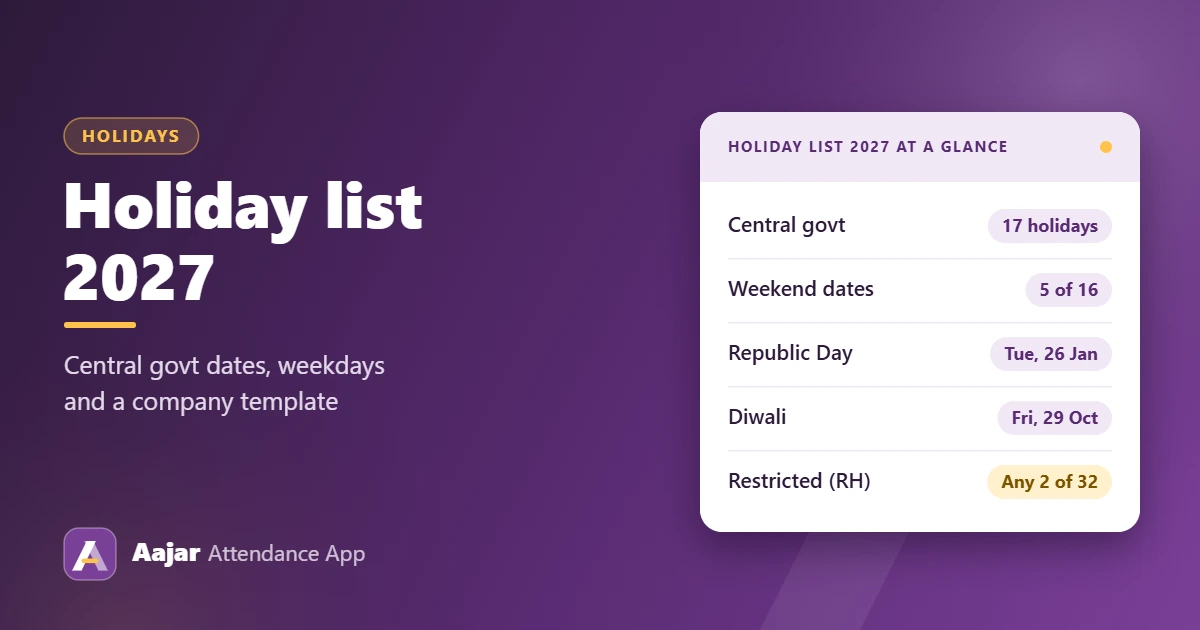
Holiday List 2027: Central Govt Dates and Company Template
All 17 central government holidays for 2027 with weekdays, what is left of 2026, state festival holiday rules and a sample company holiday list template.

Leave Application Format: Letter and Email Samples for Office
Copy-ready leave letters and leave request emails for office, the six parts every application needs, and how to count your leave days.
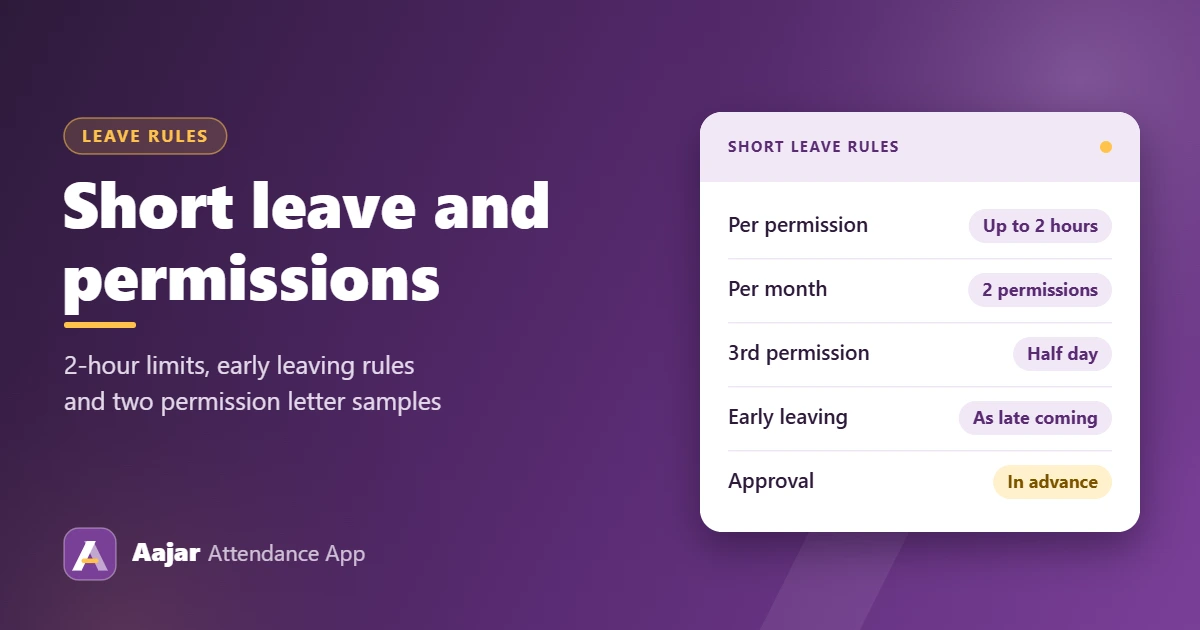
Short Leave in Office: Rules, Limits and Permission Letters
How 2-hour permissions, monthly limits and early leaving work, how to record them, plus two permission letter samples for office.