Short Leave in Office: Rules, Limits and Permission Letters
How 2-hour permissions, monthly limits and early leaving work, how to record them, plus two permission letter samples for office.
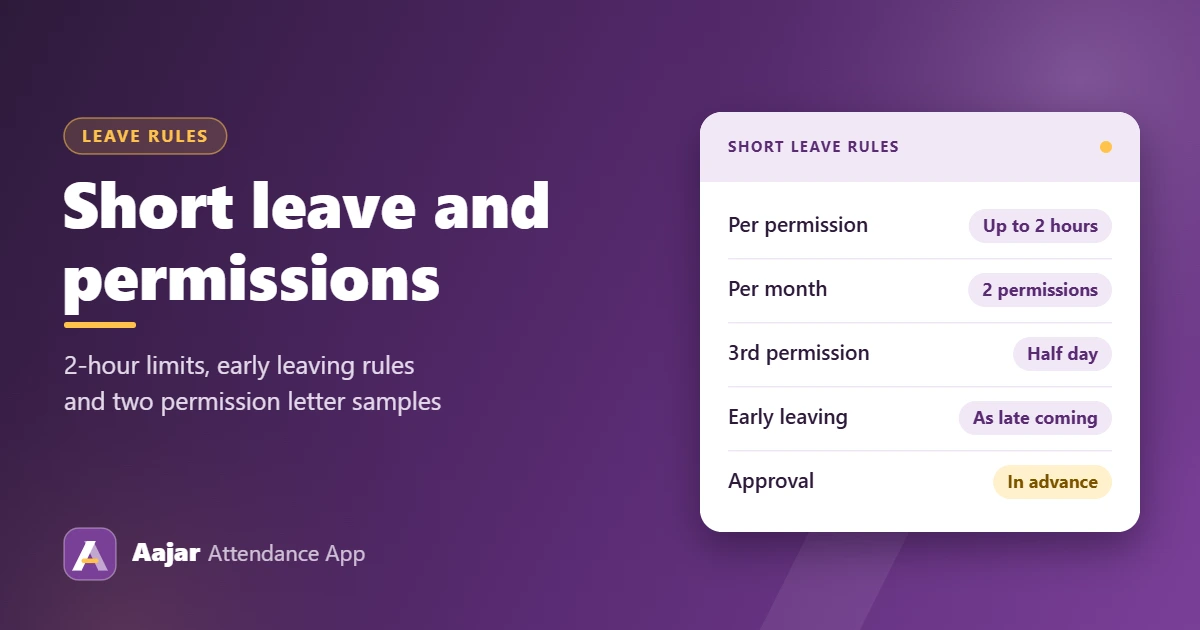
Short answer: Short leave is permission to be away from work for a few hours, usually up to two hours, for arriving late or leaving early, without taking a full or half day off. Many Indian companies allow one to three short leaves a month and convert extra ones into half-day leave. The employee asks in advance, often through a short permission letter or app request, and the manager approves it.
This guide explains how short leave and early leaving work in practice, how to set sensible limits, how to record permissions correctly, and how to write a permission letter for office. It includes two ready-to-use samples.
What is short leave in office?
Short leave, often called "permission" in Indian offices, is a few hours of approved absence during a working day. The employee comes in late, leaves early, or steps out in the middle of the day for a fixed, short period.
Common reasons include a bank or government office visit, a doctor's appointment, a child's school meeting or a delayed train. The employee still counts as present for the day, as long as they stay within the permission limits.
Short leave is a company policy, not a statutory leave type. Each company decides how many hours, how many times a month and what happens when someone goes over.
How many hours is a short leave?
Many companies set short leave at one to two hours per occasion. Two hours is the most common upper limit, because anything longer starts to look like a half day.
Some companies allow a single block of two hours, while others allow two separate one-hour permissions. Decide which works for you and write it down, so employees and managers apply the same rule.
How many short leaves are allowed in a month?
A common approach is two permissions a month, with a few companies allowing three. Some set the limit in hours instead, such as four hours a month in total.
When the limit is crossed, many policies convert the extra permission into half-day leave, deducted from casual leave or treated as leave without pay if no balance is left. Whatever your rule is, state it clearly in the leave policy.
Short leave vs half day vs late coming: what is the difference?
These three are often mixed up, which causes payroll disputes. The table below separates them.
| Situation | Typical time away | Approved in advance? | Usual effect |
|---|---|---|---|
| Short leave (permission) | Up to 2 hours | Yes | Counted present, uses monthly permission quota |
| Half-day leave | About half the shift | Yes | Half a day deducted from leave balance |
| Late coming within grace | A few minutes | No | No effect, within grace period |
| Late coming beyond grace | Varies | No | Marked late; repeated cases may become half day |
| Unapproved early leaving | Varies | No | Treated like late coming under most policies |
The key difference is approval. A short leave is planned and approved; late coming and unapproved early leaving are not.
What do central government rules say about late coming and early leaving?
Private companies are not bound by central government service rules, but these rules are a useful benchmark. The Department of Personnel and Training's office memorandum on punctuality dated 15 June 2024 repeats the long-standing rule that half a day's casual leave is debited for each day of late attendance.
The same memorandum says late attendance of up to an hour may be condoned on not more than two occasions in a month, for justifiable reasons. It also says early leaving is to be treated in the same manner as late coming.
Many private employers follow a similar shape: a small monthly allowance, then a half-day deduction. You do not have to copy it, but it shows that "two a month" is a widely understood starting point.
What is early leaving, and how should companies handle it?
Early leaving means going home before the shift ends. If it is approved in advance as a short leave, it is simply a permission. If it is not approved, most companies treat it the same way as late coming.
A fair early leaving rule usually has three parts:
- Approval first: the employee asks the manager before leaving, even if only by message.
- Counts towards the quota: approved early leaving uses one of the month's permissions.
- Unapproved exits are recorded: leaving without approval is marked as early going and handled under the late coming rule.
If people often forget to punch out after an approved early exit, the record will look wrong at month end. Our guide on attendance regularization explains how employees can correct missed punches with approval.
How do you write a permission letter for office?
A permission letter for office should be short and specific. Include the date, the exact time you will be away, the reason in one line, and how urgent work will be handled.
Send it to your reporting manager, and copy HR if your company asks for it. Email or a message in your attendance app is enough in most offices; a printed letter is rarely needed today.
Sample 1: Permission letter for coming late
Subject: Permission to come late on 6 November 2026
Dear Ms Sharma,
I request permission to report at 11:00 am instead of 9:30 am on Friday, 6 November 2026. I have to visit the bank to complete a home loan document verification, which is only possible during their morning hours.
I will be reachable on my phone during this time and will complete the pending invoice report by the end of the day. I understand this will count as one permission for the month.
Thank you,
Rahul Verma
Accounts Executive
Sample 2: Permission letter for early leaving
Subject: Permission to leave early today
Dear Mr Iyer,
I request permission to leave at 4:00 pm today, 30 October 2026, instead of 6:00 pm. I have a doctor's appointment for my mother at 4:45 pm.
I have shared today's dispatch list with Anita, who has agreed to handle any calls from the warehouse after I leave. I will check my messages once the appointment is over.
Regards,
Priya Nair
Logistics Coordinator
You can adapt either sample for a mid-day permission by stating both the time you will leave and the time you will return.
How should managers approve short leave requests?
Approving permissions is quick, but a little consistency avoids complaints about favouritism. A few simple habits help.
- Reply the same day: a late approval is almost as unhelpful as a refusal.
- Check the month's count: know whether this is the first or the third permission before you approve.
- Look at the team: avoid having two people from a small team away during the same peak hour.
- Use the same rule for everyone: if a senior person's permissions are not recorded, juniors notice.
How do you record short leave in attendance?
The record should show three things: the date, the hours away and whether the permission was approved. Without this, payroll has to rely on memory at month end.
In a paper or Excel system, add a "Permission" column next to the in and out times, and keep a monthly count per employee. In an app, the permission request itself becomes the record, linked to the day's punch in and punch out times.
Whatever system you use, review the monthly count before payroll is processed. That is the point where extra permissions convert to half days, so it must happen before salaries are finalised.
Worked example: short leave limits in a 45-person logistics company
A 45-person logistics company runs a 9:30 am to 6:30 pm shift with a 10-minute grace period. Its policy allows two permissions a month, each up to two hours. A third permission in the same month becomes half-day leave, taken from casual leave or as leave without pay if no casual leave is left.
In October 2026, a dispatch executive earning ₹24,000 a month takes three permissions: two hours on 7 October, one and a half hours on 15 October and two hours on 27 October. She has no casual leave left.
- Permissions 1 and 2: within the limit, so no deduction.
- Permission 3: converts to half-day leave without pay.
- The company's policy calculates daily pay on 26 days: ₹24,000 ÷ 26 = ₹923.08 a day.
- Half-day deduction: ₹923.08 ÷ 2 = ₹461.54.
- October salary: ₹24,000 − ₹461.54 = ₹23,538.46, rounded to ₹23,538 as per the company's rounding rule.
Total time away in the month was 2 + 1.5 + 2 = 5.5 hours. Note that she lost half a day's pay for a two-hour absence, which is why the rule must be written down and shared in advance. The divisor (26 days, 30 days or actual working days) is a company choice, so use the one your payroll already follows.
What should a short leave policy include?
A one-page policy is enough for most small and mid-sized companies. Cover these points:
- Maximum hours per permission (for example, two hours)
- Number of permissions per month (for example, two)
- Whether permissions can be split or combined
- How to request (email, app) and who approves
- What happens when the limit is crossed (half day from CL, then leave without pay)
- How unapproved late coming and early leaving are treated
- Whether unused permissions lapse at month end (they usually do)
- Rules for shift workers, if shift times differ
For teams on rotating shifts, set the permission window relative to each shift's start and end time rather than to office hours.
Managing short leave on Aajar
Aajar includes permission (short absence) requests on every plan, including Starter. Employees send a permission request from their phone or computer, the manager approves it, and it sits alongside the day's check-in and check-out times, late grace rules and half-day rules you have set up.
HR reviews the month's permissions before running payroll from the same records and applies any half-day deduction there. See Aajar pricing: every plan is free for 3 months for teams of up to 50 users.
Frequently asked questions
What is short leave in office?
Short leave is approved time away from work for a few hours, usually up to two, to come in late, leave early or step out during the day. The employee is still counted as present, within the company's monthly permission limit.
How many short leaves are allowed in a month?
There is no law fixing this for private companies, so it depends on company policy. A common approach is two permissions a month of up to two hours each, with extra ones converted to half-day leave.
Is early leaving counted as half day?
Approved early leaving within the permission limit is usually not counted as a half day. Unapproved early leaving, or leaving early beyond the monthly limit, is often treated like late coming and may convert to half-day leave under the company's policy.
How do I write a permission letter for leaving early?
Mention the date, the time you want to leave, a one-line reason and who will handle urgent work after you go. Keep it to a few lines and send it to your reporting manager before you leave.
What is the difference between short leave and half-day leave?
Short leave covers a few hours and uses the month's permission quota, without reducing your leave balance. Half-day leave covers roughly half the shift and is deducted from your leave balance or treated as unpaid.
This article is general information, not legal advice.
Keep reading
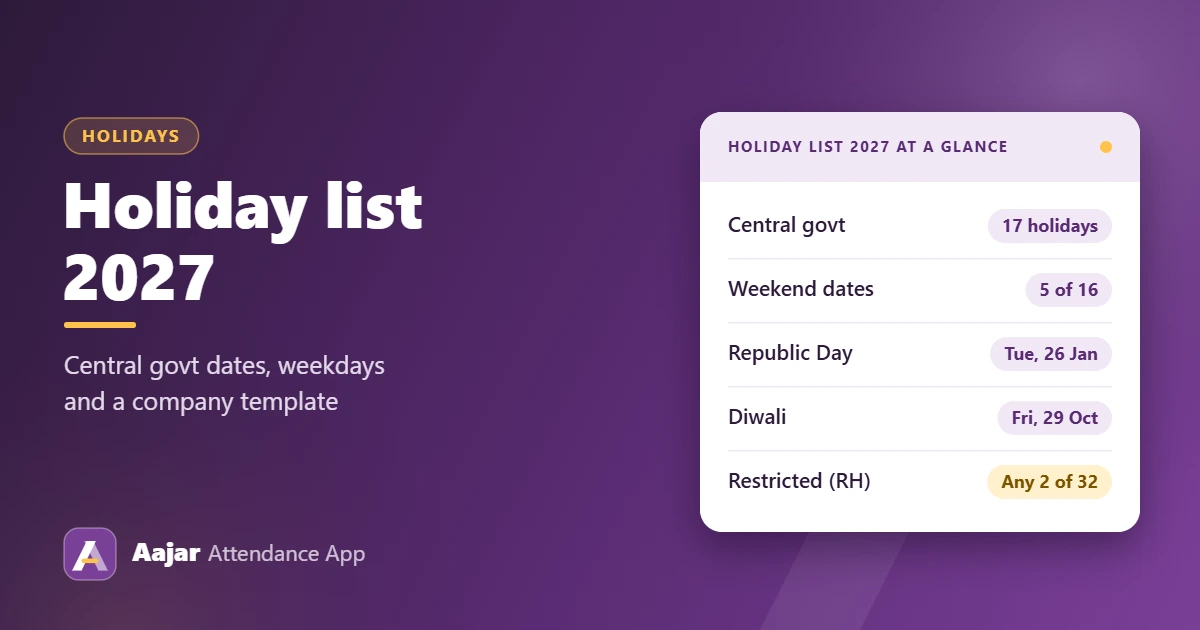
Holiday List 2027: Central Govt Dates and Company Template
All 17 central government holidays for 2027 with weekdays, what is left of 2026, state festival holiday rules and a sample company holiday list template.

Leave Application Format: Letter and Email Samples for Office
Copy-ready leave letters and leave request emails for office, the six parts every application needs, and how to count your leave days.
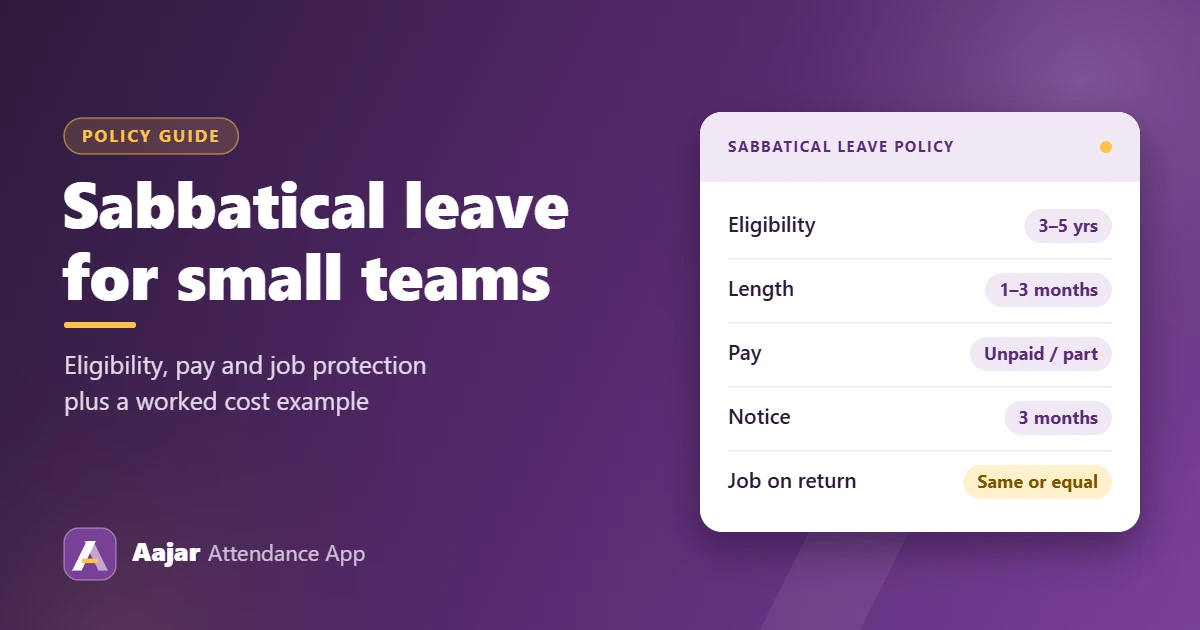
Sabbatical Leave: A Practical Policy Guide for Small Companies
How a small company can offer sabbaticals: eligibility, paid or unpaid, job protection, cover planning and a worked cost example.