Earned Leave Rules in India: State-wise Guide (2026)
Earned leave under the OSH Code and the shops and establishments Acts of eight states, with carry-forward caps, encashment and worked examples.
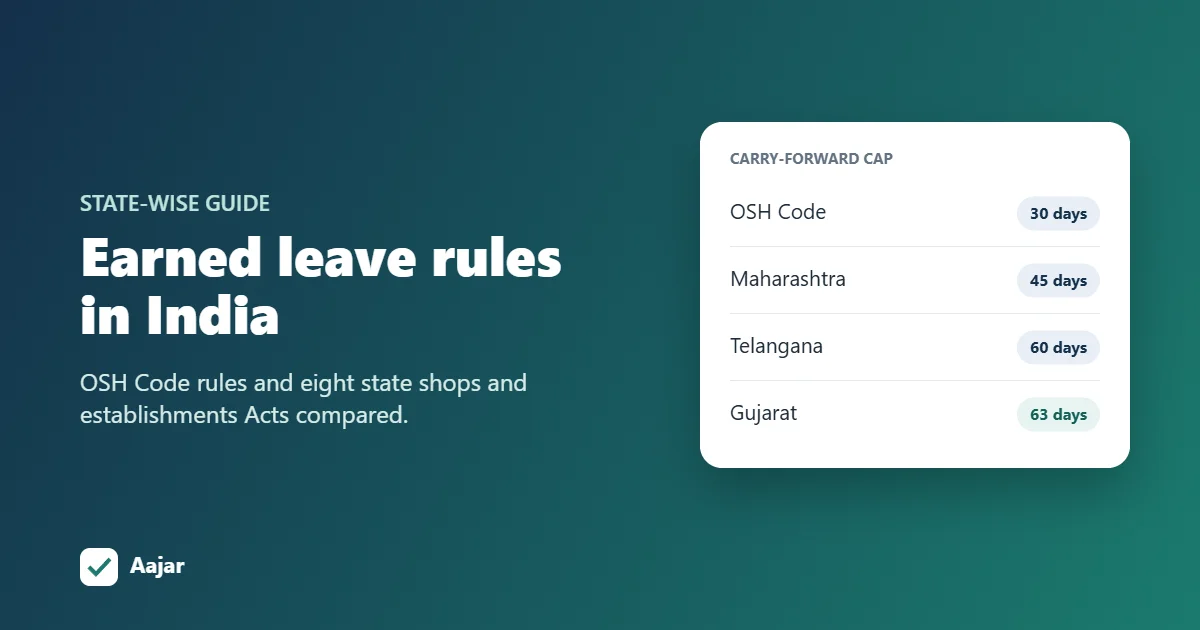
Short answer: under the OSH Code, 2020, a worker who has worked at least 180 days in a calendar year earns 1 day of earned leave for every 20 days worked. Up to 30 days can be carried forward, and leave can be encashed at the end of the year. State shops and establishments Acts often give more: most allow 15 days or more a year with carry-forward caps of 45 to 63 days. Where a contract or state law is more generous, employees get the better terms.
This guide covers the central rule, a state-by-state table for the eight largest employer states, how to calculate earned leave, and how encashment works when someone leaves.
What is earned leave?
Earned leave (EL), also called privilege leave (PL) or annual leave, is paid leave an employee builds up by working. Unlike casual or sick leave, it usually carries forward to the next year and can be paid out on exit. The OSH Code calls it "annual leave with wages".
Earned leave under the OSH Code, 2020
The OSH Code has been in force since 21 November 2025. Section 32 sets these rules for every worker in an establishment it covers (OSH Code text, India Code):
| Rule | What Section 32 says |
|---|---|
| Eligibility | 180 days or more of work in a calendar year |
| Accrual | 1 day for every 20 days worked (1 for every 15 days for adolescents and underground mine workers) |
| Joining mid-year | Leave earned pro-rata if the worker works at least a quarter of the remaining days of the year |
| Days counted towards 180 | Lay-off, maternity leave and leave days count towards eligibility but don't earn leave themselves |
| Holidays during leave | Not counted as leave days |
| Carry forward | Up to 30 days; leave applied for and refused carries forward without a cap |
| Encashment | The worker can ask for encashment at the end of the calendar year |
| On exit | Wages for unused leave paid within 2 working days of resignation, dismissal or discharge |
| Better terms | A contract or award that gives more leave prevails (s.32(3)) |
Who counts as a worker: the OSH Code excludes people in managerial or administrative roles, and supervisors earning more than ₹18,000 a month. For them, earned leave comes from the state shops and establishments Act, if it covers them, and from the employment contract.
Earned leave rules by state
Shops, offices and other commercial establishments are covered by state shops and establishments (S&E) Acts, which still apply alongside the labour codes. These are the earned leave rules in eight major states:
| State (Act) | Earned leave | Carry-forward cap | Sick and casual leave |
|---|---|---|---|
| Maharashtra (2017) | 1 day per 20 days worked after 240 days; or 5 days per 60 days worked after 3 months | 45 days | 8 days casual leave; 8 festival holidays |
| Karnataka (1961) | 1 day per 20 days worked | 45 days (raised from 30 in 2020) | Up to 12 days sick or casual |
| Tamil Nadu (1947) | 12 days after 12 months' continuous service | 45 days | 12 days sick + 12 days casual |
| Delhi (1954) | 15 days per year of service | 45 days | 12 days sick or casual |
| Telangana (1988) | 15 days after 240 days in 12 months | 60 days | 12 days sick + 12 days casual |
| Gujarat (2019) | 1 day per 20 days worked after 240 days | 63 days | 7 days casual + 7 days medical; 8 festival holidays |
| West Bengal (1963) | 14 days per completed year | 28 days | 14 days sick at half pay; 10 days casual |
| Uttar Pradesh (1962) | At least 15 days after 12 months | 45 days | At least 15 days sick after 6 months |
Sources: AZB & Partners on Maharashtra; Lexplosion on Karnataka's 2020 amendment; Tamil Nadu Act; Delhi Labour Department; Telangana Act; Gujarat Act; Uttar Pradesh Act. State Acts and notifications change; sources disagree on some caps (for example, Tamil Nadu's), so confirm the current figure with your state's labour department or your advisor.
Which rule applies: OSH Code or state Act?
Many businesses are covered by both. The OSH Code itself says a contract or award with more favourable leave prevails, and in practice employers follow whichever rule is better for the employee. For most shops and offices, that means the state Act's higher carry-forward cap and the more generous accrual.
How to calculate earned leave
Example 1: the OSH Code rule
A factory worker works 260 days in 2026. She has worked more than 180 days, so she qualifies.
260 ÷ 20 = 13 days of earned leave for 2026, available in 2027.
Example 2: a mid-year joiner
A worker joins on 1 July and works 110 of the remaining days. That is more than a quarter of the days left in the year, so he earns leave pro-rata: 110 ÷ 20 = 5.5 days, which most employers round down to 5.
Example 3: monthly credit
Many offices convert the annual entitlement into a monthly credit to keep it simple. For 15 days a year, that is 1.25 days a month; for 18 days, 1.5 days a month. Whatever you choose, make sure the yearly total is at least what your state Act requires.
Carry forward and encashment
- Carry forward: unused earned leave moves to the next year up to the cap: 30 days under the OSH Code, or the state cap, whichever your policy follows.
- Above the cap: under the OSH Code, leave above 30 days can be encashed at year end. Some state Acts let leave above the cap lapse unless it was refused.
- On exit: unused earned leave is paid when someone resigns or is let go. Under the OSH Code, this is due within 2 working days.
How leave encashment is calculated
Most employers pay encashment at the employee's daily basic wage (plus DA, if any) multiplied by the unused days. For example, if basic + DA is ₹26,000 a month and the employee has 12 days left: ₹26,000 ÷ 26 = ₹1,000 a day, so the payout is ₹12,000. Some companies divide by 30 instead of 26; your policy should say which.
Encashment on resignation or retirement is taxable salary. Non-government employees get an income-tax exemption only on retirement, up to the limit set under Section 10(10AA). Ask your CA for the current limit.
How Aajar handles earned leave
Aajar lets you set up earned leave on every plan, from ₹20 per user per month:
- Monthly credit for each leave type, such as 1.25 days of earned leave a month.
- Your own leave-year start and a carry-forward cap for each leave type.
- Separate policies for staff on probation.
- Balance checks: leave beyond the balance is blocked, and the employee is told to apply it as loss of pay.
- Holidays and weekly offs excluded from leave days, with an optional sandwich rule.
Two limits to know: Aajar credits leave by month rather than by days worked, and leave encashment isn't built in, so add it to payroll as a one-off amount. Read more about how a leave management system works, or start from our leave policy template.
Frequently asked questions
How many earned leaves are there in a year in India?
Under the OSH Code, 1 day for every 20 days worked, which is about 12 to 15 days a year for a full-time worker. Many state shops and establishments Acts give 12 to 15 days or more, and companies often give 15 to 21.
Who is eligible for earned leave?
Under the OSH Code, a worker who has worked at least 180 days in a calendar year. State Acts usually require 240 days or 12 months of service. Managerial staff are covered by their state Act and contract.
Can earned leave lapse?
Leave above the carry-forward cap can lapse under some state Acts and company policies. Under the OSH Code, leave above 30 days can be encashed instead, and leave that was applied for and refused is not lost.
Is earned leave encashment mandatory?
Payment for unused earned leave on exit is required under the OSH Code and most state Acts. Encashment while still employed depends on the law that applies and your policy.
Are holidays counted in earned leave?
No. Under the OSH Code, holidays that fall during a period of leave aren't counted as leave days. Weekly offs are usually treated the same way unless your policy uses a sandwich rule.
This article is general information, not legal advice. Leave law depends on your state and the type of establishment.
Keep reading
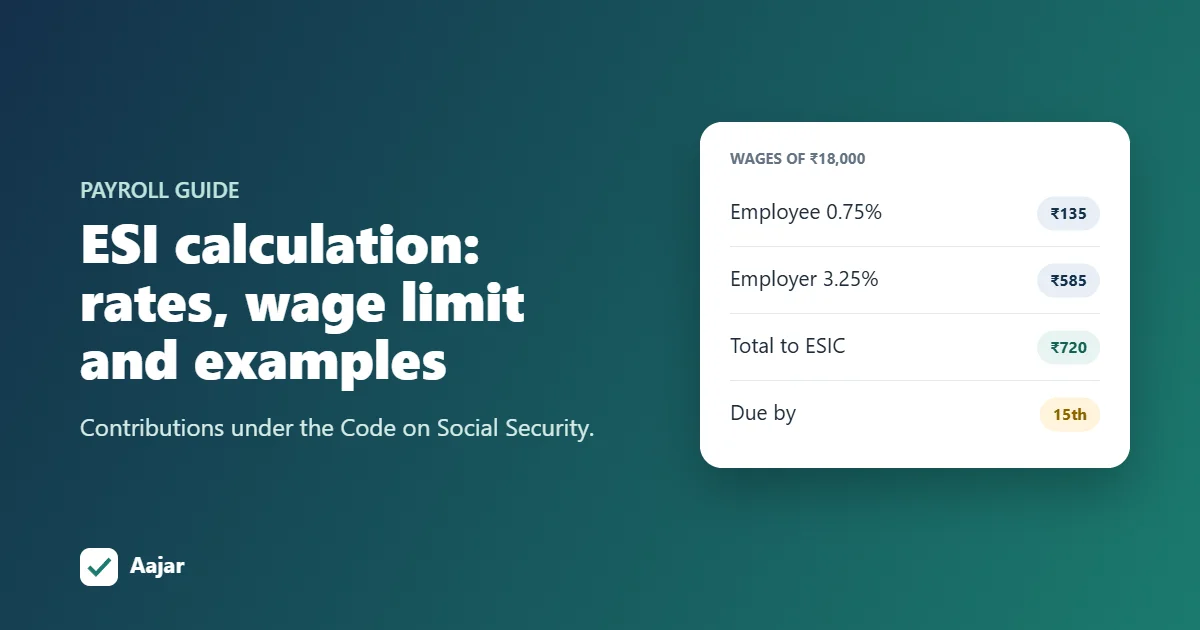
ESI Calculation: Rates, Wage Limit and Examples
How to calculate ESI in 2026: 3.25% employer and 0.75% employee, the ₹21,000 wage limit, rounding, due dates and worked examples.

How to Calculate Overtime Pay in India (with Examples)
The overtime formula under the OSH Code, 2020: twice the ordinary rate, the 26-day and 8-hour divisors, the 144-hour cap and four worked examples.
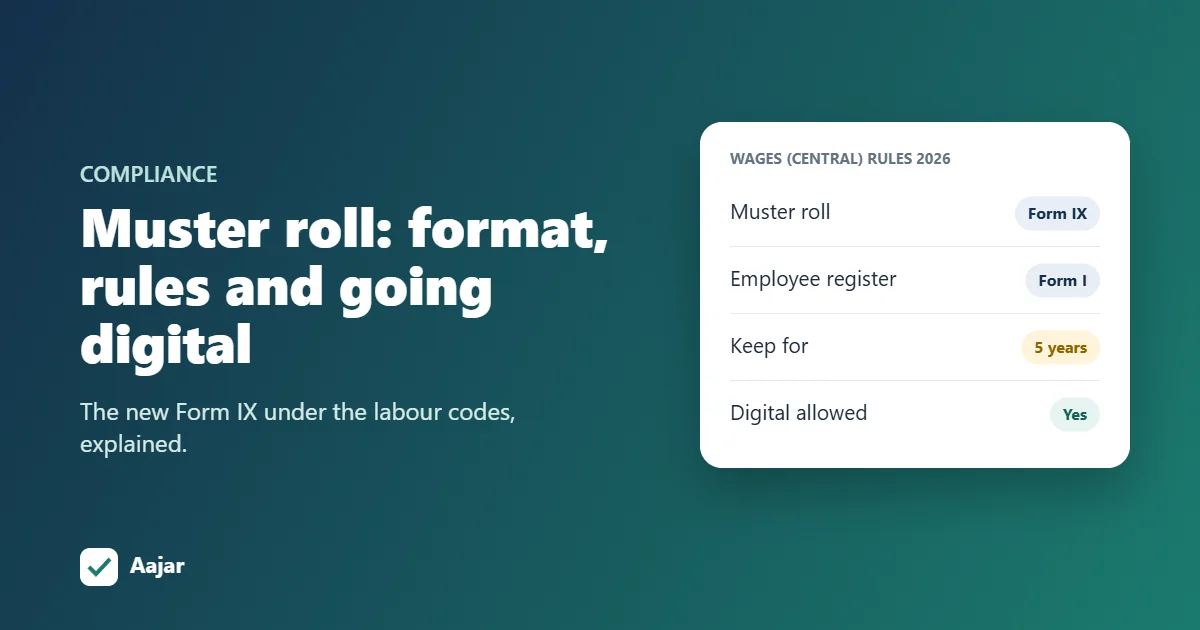
Muster Roll: Format, Legal Rules and Going Digital
What a muster roll is, the new Form IX under the Wages (Central) Rules 2026, what to record, penalties, and how to keep it digitally.