ESI Calculation: Rates, Wage Limit and Examples
How to calculate ESI in 2026: 3.25% employer and 0.75% employee, the ₹21,000 wage limit, rounding, due dates and worked examples.
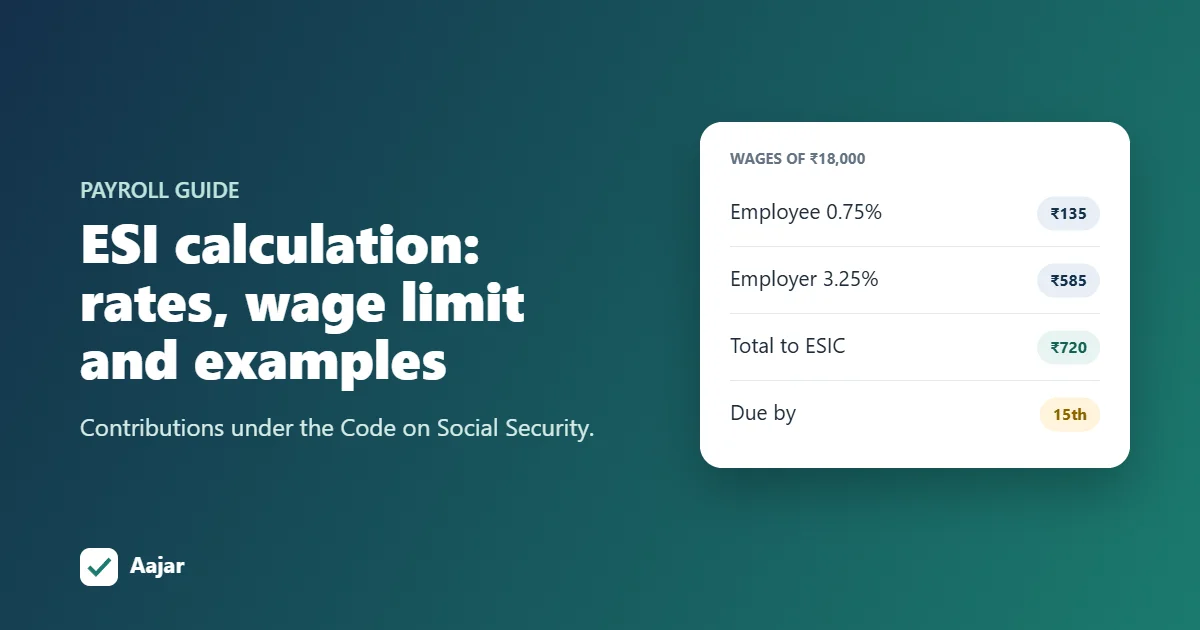
Short answer: ESI is 4% of an employee's wages: the employer pays 3.25% and the employee pays 0.75%, each rounded up to the next rupee. It applies to employees earning up to ₹21,000 a month (₹25,000 for persons with disability) in establishments with 10 or more people. For wages of ₹18,000, the employee pays ₹135, the employer pays ₹585, and ₹720 goes to ESIC. Contributions are due by the 15th of the following month.
This guide explains the ESI rates, the wage limit, how to calculate contributions with examples, and what changed under the Code on Social Security, 2020.
ESI contribution rates
| Who pays | Rate | On wages of ₹18,000 |
|---|---|---|
| Employee | 0.75% | ₹135 |
| Employer | 3.25% | ₹585 |
| Total | 4% | ₹720 |
These rates are set by Rule 19(1) of the Social Security (Central) Rules, 2026, which replaced the ESI (Central) Rules, 1950 in May 2026. Each share is rounded up to the next higher rupee (Taxmann; Tally).
ESI wage limit
- ₹21,000 a month for most employees.
- ₹25,000 a month for persons with disability.
- Low earners: employees whose average daily wage is ₹176 or less don't pay the employee share. The employer still pays 3.25%.
- Overtime counts for contributions but not for checking whether someone is above the limit.
Under the Code on Social Security, a new ESI wage ceiling has not yet been notified; the ₹21,000 limit continues under the Code's transition provisions (Taxmann). Watch for a notification that changes it.
How to calculate ESI: step by step
- Work out the employee's ESI wages for the month (see "What counts as wages" below).
- Check eligibility: wages at the start of the contribution period are ₹21,000 or less.
- Employee share = wages × 0.75%, rounded up to the next rupee.
- Employer share = wages × 3.25%, rounded up to the next rupee.
- Deduct the employee share from salary and pay both shares to ESIC by the 15th of the next month.
ESI calculation examples
| Monthly wages | Employee 0.75% | Employer 3.25% | Total |
|---|---|---|---|
| ₹12,000 | ₹90 | ₹390 | ₹480 |
| ₹15,450 | ₹116 (115.875 rounded up) | ₹503 (502.125 rounded up) | ₹619 |
| ₹18,000 | ₹135 | ₹585 | ₹720 |
| ₹21,000 | ₹158 (157.50 rounded up) | ₹683 (682.50 rounded up) | ₹841 |
| ₹4,500 (daily average ₹150) | ₹0 (below ₹176 a day) | ₹147 (146.25 rounded up) | ₹147 |
Our calculations from the Rule 19 rates and rounding rule.
Example: an employee crosses ₹21,000 mid-period
Priya earns ₹20,500 a month in April, so she is covered for the April to September contribution period. In July she gets a raise to ₹23,000. ESI contributions continue on her full wages until 30 September, the end of that period. From October she is no longer covered.
Contribution periods and benefit periods
| Contribution period | Matching benefit period |
|---|---|
| 1 April to 30 September | 1 January to 30 June of the following year |
| 1 October to 31 March | 1 July to 31 December |
Whether an employee is covered is decided at the start of each contribution period. Coverage continues to the end of that period even if wages go above the limit (Treelife).
Due date and late payment
- Contributions for a month are due by the 15th of the following month. For example, April's contributions are due by 15 May.
- Late payment attracts interest at 12% a year, and damages can also be charged.
Who must register for ESI
- 10 or more people: under the Code on Social Security, every non-seasonal establishment employing 10 or more persons is covered. Under the old ESI Act, some states used a threshold of 20 for certain establishments.
- Hazardous occupations: establishments in occupations notified as hazardous or life-threatening are covered even with one employee.
- Voluntary coverage: smaller employers can opt in.
- Area: contributions apply from the date ESIC starts providing benefits in your district, so check that ESIC is active where you operate.
Sources: Taxmann; Simpliance.
What counts as wages for ESI
This is the area with the most confusion since the labour codes came in. The Code on Social Security uses a definition of wages based on basic pay, DA and retaining allowance, with excluded allowances such as HRA added back when they exceed 50% of pay. Some payroll guides still compute ESI on gross pay including HRA and fixed allowances. Overtime is included either way, and reimbursements, gratuity, leave encashment and employer contributions are excluded.
Because sources disagree, confirm the wage base with your CA or ESIC before your next filing.
ESI vs PF at a glance
| ESI | PF | |
|---|---|---|
| Purpose | Medical care and cash benefits during sickness, maternity and injury | Retirement savings |
| Employee share | 0.75% | 12% of basic + DA |
| Employer share | 3.25% | 12% of basic + DA (split between EPF and EPS) |
| Wage limit | ₹21,000 a month | ₹15,000 a month for mandatory coverage |
ESI in your payroll software
If you run payroll in an app, check how it handles ESI: does it apply the ₹21,000 limit and the contribution-period rule, round each share up, and produce the challan or return? In Aajar, you add ESI as a named deduction type in the salary structure, and it appears on payslips. Aajar doesn't calculate the contribution automatically or file ESIC returns, so your accountant enters the amount and files on the ESIC portal. If you want filing automated, see our comparison of the best HRMS software in India, which covers tools that generate ESI challans. Loss of pay and overtime from attendance flow into Aajar payslips; see how overtime is calculated.
Frequently asked questions
What is the ESI percentage for 2026?
4% of wages: 3.25% from the employer and 0.75% from the employee.
What is the ESI wage limit?
₹21,000 a month, or ₹25,000 for persons with disability.
How is ESI rounded?
Each share is rounded up to the next whole rupee. On wages of ₹15,450, the employee's share of ₹115.875 becomes ₹116.
Is ESI deducted on overtime?
Yes. Overtime is included in wages for calculating contributions, but not when checking whether the employee is under the ₹21,000 limit.
Is ESI mandatory for 10 employees?
Yes. Under the Code on Social Security, establishments with 10 or more employees are covered, provided ESIC operates in the area.
When is ESI payment due?
By the 15th of the month after the wage month.
This article is general information, not legal or tax advice. ESI rules are being updated under the Code on Social Security; check ESIC notifications before filing.
Keep reading

How to Calculate Overtime Pay in India (with Examples)
The overtime formula under the OSH Code, 2020: twice the ordinary rate, the 26-day and 8-hour divisors, the 144-hour cap and four worked examples.
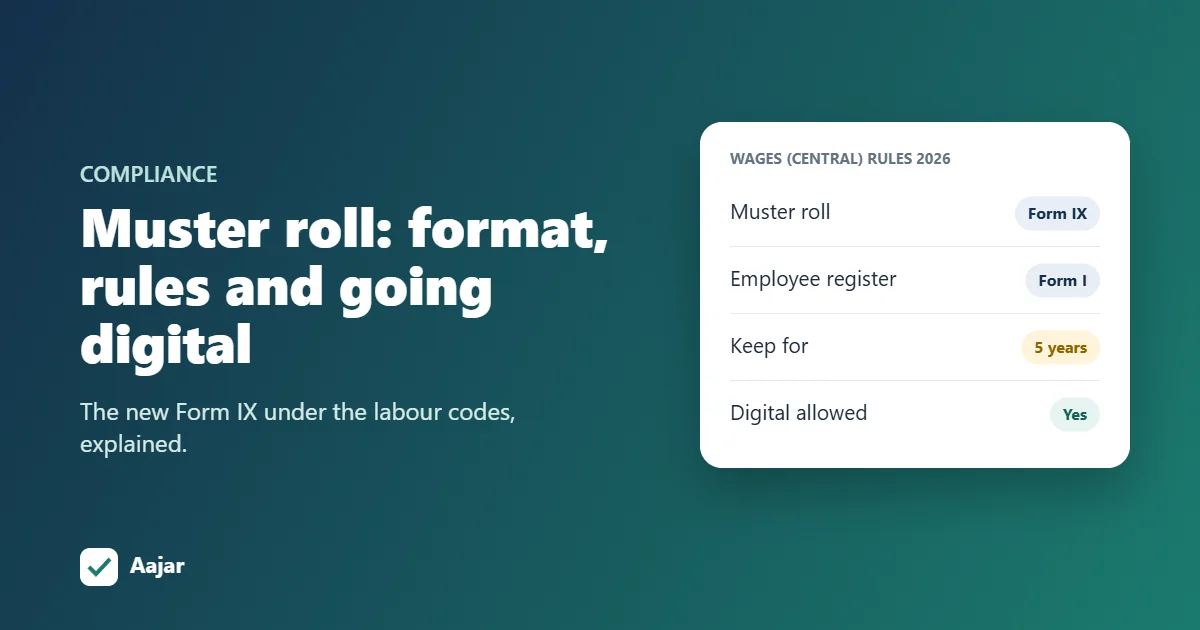
Muster Roll: Format, Legal Rules and Going Digital
What a muster roll is, the new Form IX under the Wages (Central) Rules 2026, what to record, penalties, and how to keep it digitally.
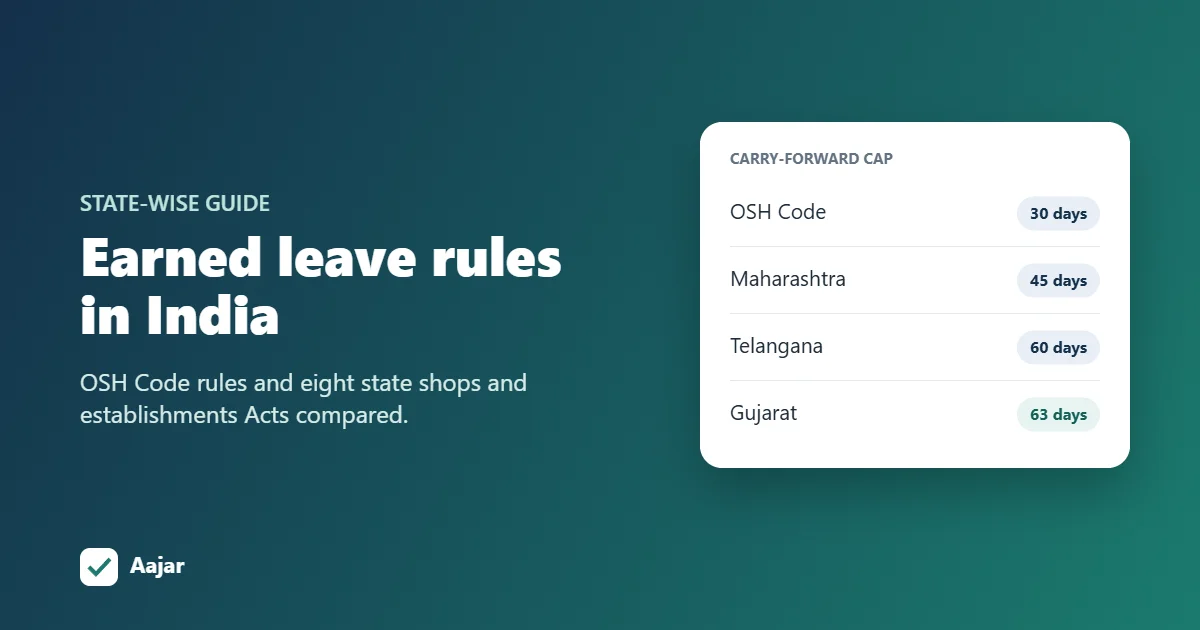
Earned Leave Rules in India: State-wise Guide (2026)
Earned leave under the OSH Code and the shops and establishments Acts of eight states, with carry-forward caps, encashment and worked examples.