Restricted Holiday and Optional Holiday: How They Work
How restricted (optional) holidays work, how many private companies give, approval and team caps, and the 2027 central government RH list as a benchmark.

Short answer: A restricted holiday (RH) is a festival holiday that each employee chooses from a list and takes off with full pay, while the office stays open for everyone else. Central government staff can pick two restricted holidays a year from a list, and many private companies give one to three optional holidays the same way. In private companies, "optional holiday" and "floating holiday" usually mean the same thing.
This guide explains how restricted and optional holidays work, how many to give, how approval should work, and how to build a 2027 list for a small or mid-sized team. For the wider leave set-up, see our guide to a leave management system.
What is a restricted holiday?
India has many regional and religious festivals, and no company can close for all of them. A restricted holiday solves this by letting each person pick the festivals that matter to them.
The office keeps a short list of fixed holidays when everyone is off, such as Republic Day, Independence Day and Gandhi Jayanti. It then publishes a longer list of other festivals. Each employee can take a set number of days from that longer list, usually with a manager's approval.
A restricted holiday is not deducted from casual, sick or earned leave. It is a separate, paid entitlement with its own small quota.
Is an optional holiday the same as a restricted holiday?
Mostly, yes. "Restricted holiday" is the term used by the central government and by many companies that follow its holiday pattern. "Optional holiday" and "floating holiday" are more common in private companies, especially in IT and services.
There is one difference worth knowing. Some companies let a floating holiday be used on any day, such as a birthday or anniversary, while a restricted or optional holiday must come from a published list. Decide which version you want and write it into the policy.
| Point | Fixed (gazetted or closed) holiday | Restricted / optional holiday | Floating holiday |
|---|---|---|---|
| Who is off | Whole office | Only the employee who chooses it | Only the employee who chooses it |
| Which days | Fixed dates in the calendar | Any date from a published list | Often any day, as per policy |
| Typical quota | 8 to 14 days a year in many companies | 1 to 3 days a year | 1 to 2 days a year |
| Approval | None needed | Request and manager approval | Request and manager approval |
| Unused days | Not applicable | Usually lapse at year end | Usually lapse at year end |
How do restricted holidays work for central government employees?
The central government's system is the best-known benchmark, so it helps to understand it even if you run a private company. It is set every year by an office memorandum (OM) from the Department of Personnel and Training (DoPT).
How many restricted holidays do central government employees get?
Two: DoPT holiday OMs, such as those reproduced on the DoPT circulars site, say each employee is allowed to avail any two holidays chosen by him or her out of the list of restricted holidays. The DoPT OM No. 12/2/2023-JCA dated 16 July 2026 for the year 2027, circulated by the Department of Posts, keeps the same rule.
How are the closed holidays decided?
For central government offices outside Delhi, the DoPT OMs list 14 compulsory holidays. Three more are chosen by a coordination committee in each state capital from a list of 12 festivals, such as Holi, Onam, Pongal, Ganesh Chaturthi and Makar Sankranti. The festivals left over from that list are added to the state's restricted holiday list.
This "fixed core plus personal choice" model is a useful template for private companies with staff from different regions.
Which days are on the 2027 restricted holiday list?
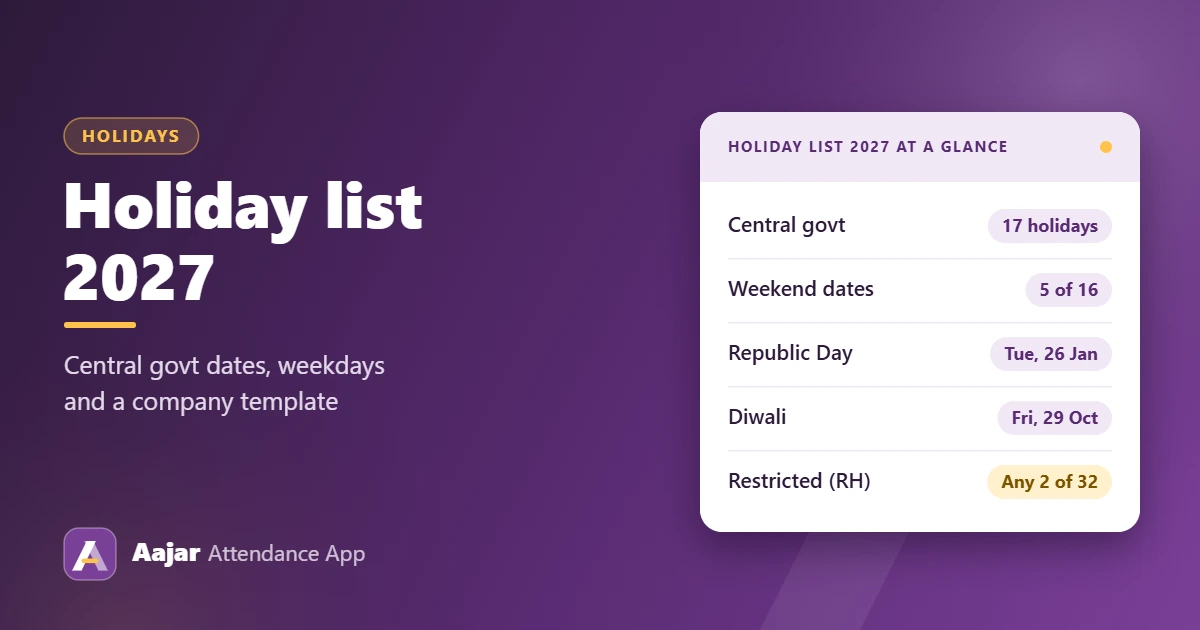
The 2027 list for central government offices in Delhi and New Delhi has 32 restricted holidays. Here are some of the dates on it, from the copy circulated by the Department of Posts linked above.
| Date (2027) | Day | Restricted holiday |
|---|---|---|
| 14 January | Thursday | Makar Sankranti / Magha Bihu |
| 15 January | Friday | Pongal; Guru Gobind Singh's Birthday |
| 7 April | Wednesday | Chaitra Sukladi / Gudi Padava / Ugadi / Cheti Chand |
| 14 April | Wednesday | Vaisakhi / Vishu / Meshadi (Tamil New Year's Day) |
| 17 August | Tuesday | Raksha Bandhan |
| 4 September | Saturday | Ganesh Chaturthi / Vinayak Chaturthi |
| 12 September | Sunday | Onam / Thiru Onam Day |
| 18 October | Monday | Karwa Chauth |
| 4 November | Thursday | Chhath Puja |
| 24 December | Friday | Christmas Eve |
A private company does not have to follow this list. It is still a handy starting point, because it already covers most regional new years and major festivals.
How many restricted holidays should a private company give?
There is no single number. A common approach in small and mid-sized companies is 8 to 12 fixed holidays plus 2 optional holidays, which mirrors the central government's two RH days.
Think about three things before you choose:
- How mixed your team is. A team drawn from several states benefits most from optional holidays, because one fixed list will never suit everyone.
- Whether you can close. A shop, clinic or warehouse that must stay open can give fewer fixed holidays and more optional ones, so the work is covered on every festival.
- Your state's fixed holiday rules. State laws can require paid national and festival holidays. For example, Punjab's 1965 Act for factories gives three national holidays (26 January, 15 August and 2 October) plus four festival holidays a year, and optional holidays sit on top of such rules.
How does an employee apply for a restricted holiday?
The process should be as simple as applying for leave. A clear policy covers these steps.
- Publish the list early. Share the fixed and optional holiday lists in December for a January to December year, or in March for an April to March year.
- Set a notice period. A common rule is at least 7 days of notice for an optional holiday, since the dates are known well in advance.
- Request and approve. The employee applies for the date, and the manager approves it, keeping in mind how many others in the team are off.
- Set a team cap if needed. On popular festivals, limit how many people from one team can be off on the same day, and approve on a first-come basis.
- Record it. The day should show as a paid optional holiday in attendance, not as leave or absence.
Is a restricted holiday paid, and does it lapse?
An approved restricted or optional holiday is a paid day off, just like a fixed holiday. The employee's salary for the month does not change.
Most companies treat unused optional holidays as lapsing at the end of the year. They are not carried forward or paid out, because the point is to take a festival off in that year. If you want a different rule, such as a carry-forward of one day, state it clearly.
Can a restricted holiday be combined with leave or a weekend?
In most private policies, yes. An employee can take an optional holiday on a Friday and add a day of earned leave on Monday. If your company uses a sandwich leave rule, clarify whether an optional holiday is treated like a holiday or like leave when it falls next to a weekend.
What if the restricted holiday falls on a weekly off?
Several festivals in 2027 fall on a weekend, such as Ganesh Chaturthi on Saturday 4 September and Onam on Sunday 12 September. A common rule is that no substitute day is given if an optional holiday falls on the employee's weekly off. Write this down so nobody expects a replacement day.
Worked example: optional holidays for a 60-person logistics company
Take a 60-person logistics company in Bengaluru with staff from Karnataka, Tamil Nadu, Kerala, Bihar and Maharashtra. The owner wants to respect everyone's festivals but cannot close the warehouse for all of them.
Option A, more fixed holidays: The owner adds Pongal, Onam, Chhath Puja and Gudi Padwa as fixed holidays. That closes the whole company for 4 extra days, which is 60 × 4 = 240 person-days of closure, and many people get days off for festivals they do not celebrate.
Option B, two optional holidays: The company keeps its fixed list and gives each employee 2 optional holidays from a published list. The maximum cost is 60 × 2 = 120 person-days, and those days are spread across the year instead of falling on the same four dates.
Team cap on a busy day: The warehouse team has 15 people and the owner caps optional holidays at 20% of a team on any day. That allows 15 × 20 ÷ 100 = 3 people off on Pongal, so the remaining 12 keep dispatch running. If 5 people apply, the first 3 approved requests are taken and the other 2 can pick another date or use earned leave.
Option B gives each person the festivals they care about, at half the person-days of Option A, while the warehouse never fully closes.
What should an optional holiday policy include?
Add these points to the holidays section of your leave policy template:
- The fixed holiday list and the optional holiday list for the year
- How many optional holidays each employee gets, and the pro-rata rule for mid-year joiners
- Notice period, approver and any team cap per day
- Whether unused optional holidays lapse
- What happens if an optional holiday falls on a weekly off
- How optional holidays interact with leave and the sandwich rule
If staff work on a fixed holiday instead, many companies give a compensatory day off. Our guide to comp-off covers how to handle that.
Managing restricted holidays on Aajar
On Aajar, the company's fixed holidays go into the holiday calendar, so attendance and leave counts treat them as holidays for everyone. For optional holidays, you can add "Restricted holiday" as a leave type with its own balance, for example 2 days a year, and employees request it like any other leave for their manager to approve. The day then shows in monthly attendance, and payroll is run from the same records.
The holiday calendar, leave types, balances and approvals are all on the Starter plan, and every plan is free for 3 months for teams of up to 50 users. See Aajar pricing.
Frequently asked questions
What is RH in a holiday list?
RH stands for restricted holiday. It is a festival on the list that an employee may choose to take off with pay, while the office remains open for everyone else.
How many restricted holidays are allowed in a year?
Central government employees can choose two restricted holidays a year from the DoPT list. Private companies set their own number, and two is a common choice.
Is a restricted holiday counted as leave?
No, a restricted holiday is a separate paid entitlement and is not deducted from casual, sick or earned leave. In a private company, the policy should state this clearly so the day is not marked as leave or absence.
What is the difference between a gazetted holiday and a restricted holiday?
A gazetted or closed holiday is a fixed day when the whole office is shut. A restricted holiday is chosen by each employee from a list, and the office stays open for everyone else.
Can a manager reject a restricted holiday request?
In most private policies, yes, if too many people from the same team have asked for that day. A fair policy publishes the team cap in advance and approves requests on a first-come basis.
This article is general information, not legal advice.
Keep reading
Holiday List 2027: Central Govt Dates and Company Template
All 17 central government holidays for 2027 with weekdays, what is left of 2026, state festival holiday rules and a sample company holiday list template.

Leave Application Format: Letter and Email Samples for Office
Copy-ready leave letters and leave request emails for office, the six parts every application needs, and how to count your leave days.
Short Leave in Office: Rules, Limits and Permission Letters
How 2-hour permissions, monthly limits and early leaving work, how to record them, plus two permission letter samples for office.