On Duty (OD): Meaning, Policy and How to Track It
What OD means in attendance, how it differs from leave and WFH, how to approve it, a sample policy and tour diary, and why OD days are paid.
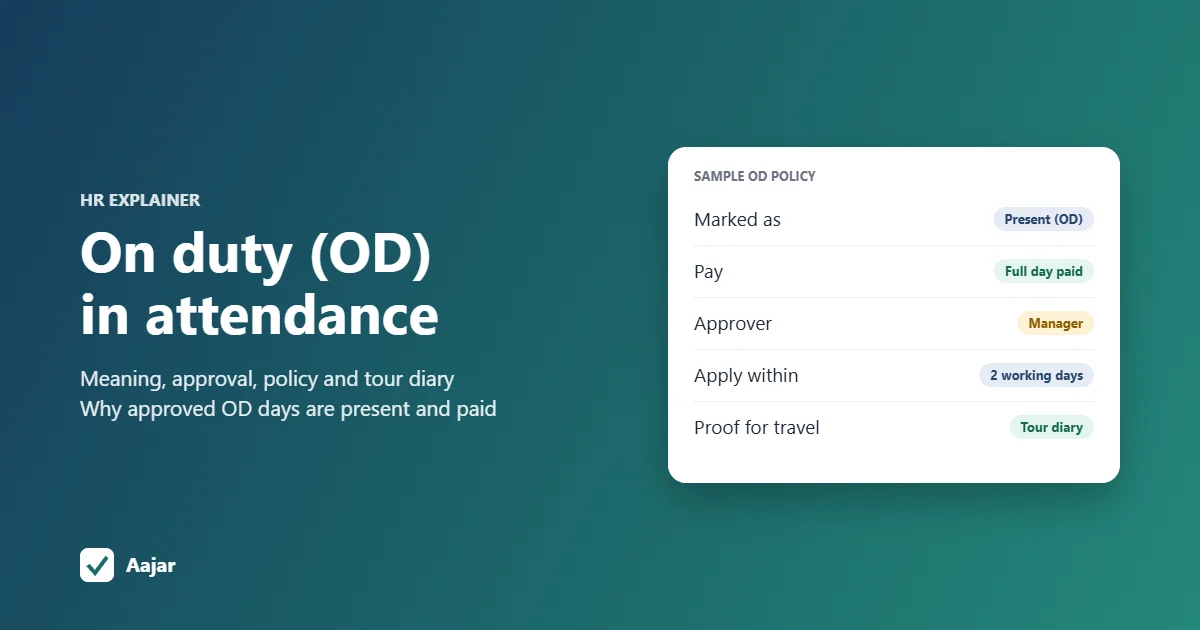
Short answer: "on duty" means working. In HR and attendance, on duty (OD) is a day or part of a day when an employee works away from the usual workplace for official reasons, such as a client visit, training, a bank or government office, a project site or official travel. An approved OD day is not leave: once the manager approves the employee's request, attendance shows "OD" instead of "absent", and the day counts as present and fully paid.
This guide covers what on duty means in attendance, how OD differs from leave, work from home and regularization, a sample OD policy, a tour diary format, and how OD days are counted for payroll.
What does on duty mean?
In everyday English, "on duty" means someone is at work and responsible for their job at that moment; "off duty" means they are not. A nurse on duty, a guard on duty at the gate, a police officer off duty: the words describe whether the person is working right now.
In Indian HR and attendance systems the phrase has a narrower meaning. "On duty" or "OD", sometimes called "outdoor duty", marks time when the employee was working but not at their desk, site or branch, so they could not check in there. One more point: in HR job titles, "OD" often stands for organisational development, which has nothing to do with attendance.
Are you on duty means what?
"Are you on duty?" simply asks "Are you working right now?" A supervisor asking a guard or a nurse this wants to know whether they are on shift. In an office, "I am on OD today" means "I am working outside the office today, with approval."
What counts as on duty (OD) in attendance?
OD covers official work done away from the employee's usual place of work. Common examples in Indian SMEs:
- Client or customer visits: a sales executive meeting distributors, a service engineer at a customer site.
- Bank, tax or government office work: an accounts assistant depositing cheques or visiting the GST office.
- Training, seminars and exhibitions: a day at a trade fair or an external course paid for by the company.
- Work at another branch, warehouse or site: a supervisor covering a second store for the day.
- Official travel (tour): travel to another city for work, usually tracked in a tour diary.
- Vendor and supplier visits: a purchase executive inspecting material at a supplier's factory.
What is not OD: personal errands, a doctor's appointment, a delayed train on the way to work, or working from home. Those are leave, permission (short absence), regularization or WFH, as the next table shows.
On duty vs leave vs work from home vs regularization
These four are often mixed up because each one changes a day that would otherwise show as absent. The difference is where the employee was and whether they were working.
| On duty (OD) | Leave | Work from home (WFH) | Regularization | |
|---|---|---|---|---|
| Was the employee working? | Yes | No | Yes | Yes |
| Where? | Away from the usual workplace, on company work | Not working | At home | At the usual workplace |
| Why is a request needed? | They could not check in at the office | To use a leave balance | They were not at the office by choice or policy | A punch was missed or wrong |
| Uses leave balance? | No | Yes (or loss of pay) | No | No |
| Marked in attendance as | Present (OD) | Leave type, e.g. CL, EL | Present (WFH) | Present, with corrected times |
| Usually applied | Before, or within a few days after | Before, except sick leave | Before | After the missed punch |
A useful test: if the employee would have been in the office but for company work elsewhere, it is OD. If they were in the office but the machine did not record it, it is regularization. For leave types and balances, see our guide to a leave management system.
How does the OD approval process work?
A typical OD process has five steps, whether on paper, email or an app.
- Employee applies with the date, full day or half day, place, purpose and expected time out of office.
- Reporting manager approves or rejects, ideally within one working day. The manager is the one who knows whether the visit was real.
- Proof is attached where needed: a visit report, client sign-off, training certificate, or a check-in with location at the site.
- HR or the time office checks that the OD does not clash with leave or a recorded punch, and that it is within the policy limit.
- Attendance is updated to show OD for that day, and the day flows to payroll as present before the month-end cut-off.
The common failure is step 5: an approval sits in a WhatsApp chat, nobody updates attendance, and the employee is shown absent on payday. Closing all pending OD requests is part of the time office's month-end routine, as described in our guide to running a time office without paper.
Sample on duty policy table
Use this as a starting point and change the values to suit your business. The numbers below are sample policy values, not legal limits.
| Policy item | Sample rule |
|---|---|
| Who can apply | All confirmed and probation employees |
| Valid reasons | Client visit, bank or government office, training, other branch or site, official travel |
| When to apply | Before going; if not possible, within 2 working days after |
| Full day or half day | Half-day OD if out of office for up to 4 hours; full day above that |
| Approver | Reporting manager; HR checks before payroll |
| Proof | Visit report or check-in with location at the site; tour diary for travel |
| Monthly limit (office roles) | 4 days a month without HR review; field roles exempt |
| OD on a weekly off or holiday | Counted as a working day; compensatory off as per comp-off policy |
| Late request after cut-off | Adjusted in next month's salary |
| Misuse | False OD treated as unauthorised absence plus disciplinary action |
If an employee works on a Sunday or holiday on OD, many companies give a compensatory off rather than extra pay; see our guide to comp off rules and process. Put the final OD rules in the same document as your leave policy so employees find them in one place.
What is a tour diary and what should it include?
A tour diary is a day-by-day record an employee keeps while on official travel or field work: where they went, whom they met, how they travelled and what came of it. It supports the OD days in attendance and the travel claim in accounts. Sales, service and audit teams often fill one every working day.
Tour diary format
Here is a filled sample for a sales executive of a 40-person FMCG distributor in Pune, on a three-day tour (demo data).
| Date | From – To | Client / place visited | Purpose | Mode of travel | Time out – back | Km / fare | Outcome |
|---|---|---|---|---|---|---|---|
| 13 Oct 2026 | Pune – Satara | 3 retailers, Satara market | New outlet listing | Bus | 8:30 am – 7:00 pm | ₹420 fare | 2 outlets listed, order ₹38,500 |
| 14 Oct 2026 | Satara – Karad | Distributor, Karad | Stock review and payment follow-up | Bus | 9:00 am – 6:30 pm | ₹180 fare | ₹1,25,000 cheque collected |
| 15 Oct 2026 | Karad – Pune | 2 retailers, Karad | Display check | Bus | 9:30 am – 8:00 pm | ₹520 fare | Display fixed at 1 outlet |
At the end of the tour, add the totals (days, fares, daily allowance claimed), the employee's signature and the manager's approval. Keep the diary short and factual: its job is to show where the employee was and why, not to be a sales report.
How are on duty days counted for payroll?
An approved OD day is a paid working day. It is counted as present, does not reduce any leave balance, and does not cause loss of pay. A half-day OD with a half day in office is a full day present.
Worked example: what a missing OD entry costs
A field sales executive earns a monthly gross of ₹24,800. In October 2026 (31 days) he was on tour for 3 working days but the OD was never entered, so the system shows those 3 days as absent. The company calculates loss of pay on calendar days.
| Item | Without OD entered | With OD approved |
|---|---|---|
| Days marked absent | 3 | 0 |
| Loss of pay | ₹24,800 ÷ 31 × 3 = ₹2,400 | ₹0 |
| Gross pay for October | ₹22,400 | ₹24,800 |
The employee was working all three days, so the ₹2,400 cut is wrong and has to be paid back in the next month. Across a 25-person field team, a few missed OD entries a month turn into salary disputes and rework at every payroll run. Approving OD before the cut-off avoids both.
Do OD days count for allowances?
That depends on your policy, not on the OD itself. Many companies pay a daily allowance or travel reimbursement only for approved tour days, which is another reason to link the tour diary to the OD request.
How to track on duty for field staff
For staff who are out most days, a separate OD request every day becomes paperwork for its own sake. Two common approaches:
- Location at check-in: field staff check in on their phone from the client site, and the app records where they were. This replaces most daily OD requests.
- Geofence for fixed sites: where staff go to known sites (a warehouse, a project site), a geofence allows check-in only within a set radius of that site.
Keep OD requests for the exceptions: an office employee's bank visit, a training day or a tour. Our guide to GPS and geofence attendance for field staff explains how to set this up and what to tell employees about location tracking.
Managing on duty requests on Aajar
On Aajar, employees raise on-duty requests and managers approve or reject them in the same app that holds attendance, leave and payroll, so OD approvals don't sit in chats. On-duty requests and approvals, along with comp-off requests and geofenced check-in for field staff, are on the Growth plan at ₹35 per user per month.
Keep the tour diary itself in your own sheet or form; travel expense claims are on the Business plan (₹50). Every plan is free for the first 3 months for organisations with up to 50 users; see Aajar pricing.
Frequently asked questions
What is OD on duty?
OD stands for on duty. It is the attendance status for an employee who worked away from the usual workplace on official work, such as a client visit, training or travel, and it counts as a present, paid day.
What is OD leave in HR?
"OD leave" is a common but loose term. OD is not leave: the employee is working, so no leave balance is used and no pay is cut, as long as the OD is approved.
What is on duty and off duty?
On duty means a person is at work and responsible for their job at that time; off duty means they are not working. In attendance, "on duty" also means approved work outside the office.
Is outdoor duty the same as on duty?
Yes. Many Indian companies use "outdoor duty" for the same thing: approved work done outside the office, marked OD in attendance.
Is on duty paid?
Yes. An approved OD day is a working day and is paid in full. If OD was not entered before payroll and the day showed as absent, the deduction should be reversed in the next salary.
What is a tour diary?
A tour diary is a daily record of official travel or field work: dates, places, clients met, purpose, mode of travel and outcome. It supports OD days in attendance and travel claims.
Keep reading
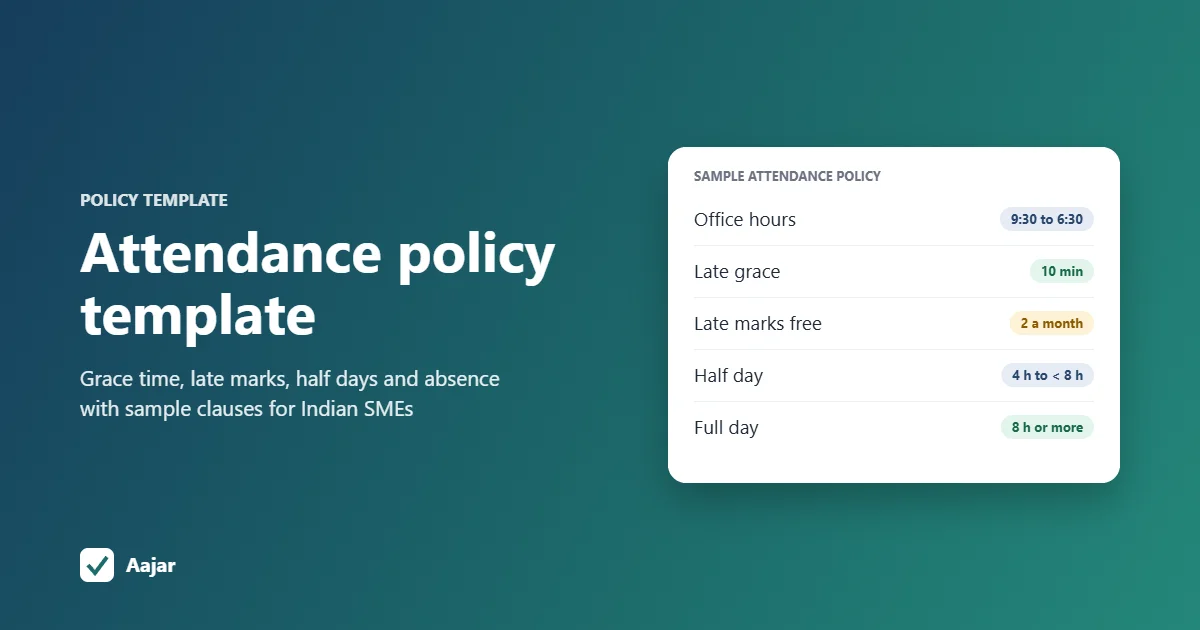
Attendance Policy Template with Late Coming Rules
A ready attendance policy template for Indian SMEs, with sample clauses for working hours, grace time, late marks, half days and absence.
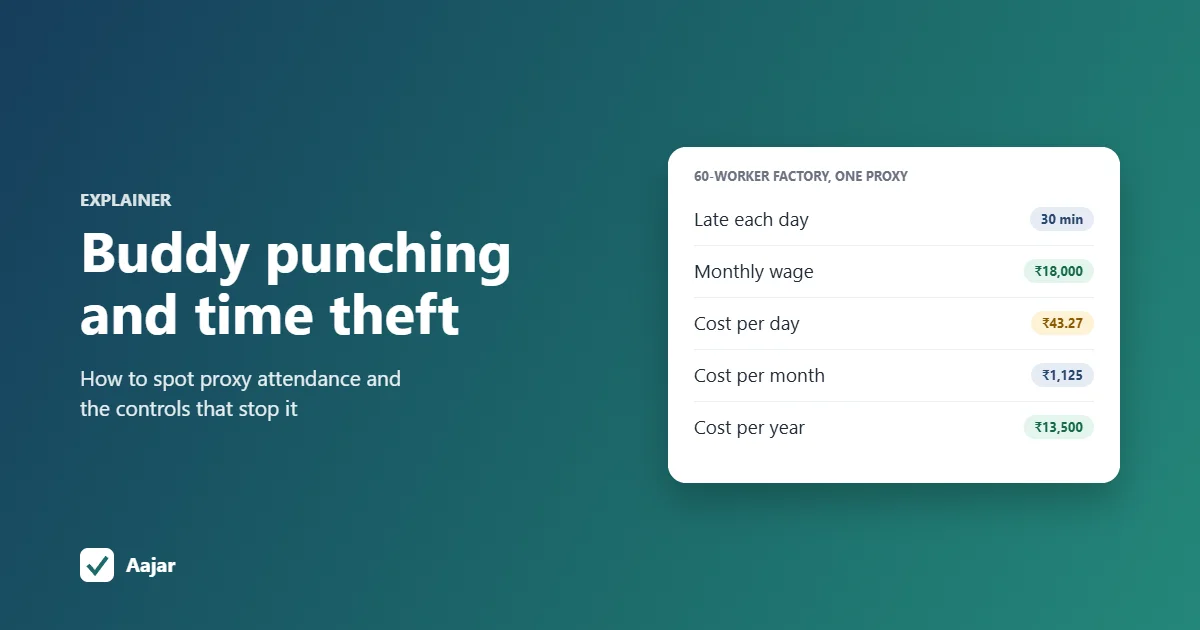
Buddy Punching and Time Theft: How to Spot and Stop Them
How proxy attendance and time theft happen, the data patterns that reveal them, what they cost a 60-worker factory, and controls that work.

Timesheet Template and When to Use Timesheets Instead of Attendance
A free weekly and daily timesheet template, Excel formulas for hours and breaks, and how timesheets differ from attendance.