Bereavement Leave: Days, Eligibility and Sample Policy
Who counts as family, how many days to give, when to ask for a death certificate, and a ready bereavement leave clause for Indian SMEs.
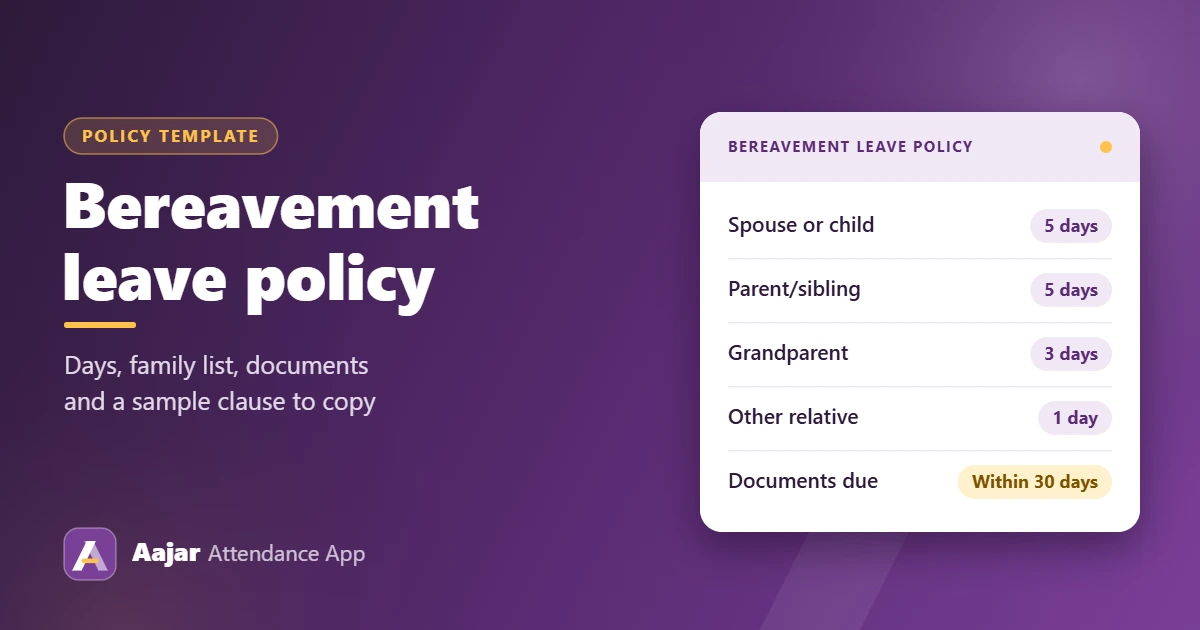
Short answer: Bereavement leave is paid time off an employee takes after the death of a close family member, to attend the funeral, complete rituals and handle family matters. In Indian companies it usually comes from the company's own leave policy. A common range is 3 to 5 days for immediate family and 1 to 2 days for extended family, with a few extra days allowed from other leave.
This guide is for owners, HR and managers at small and mid-sized Indian teams. It covers who counts as family, how many days to give, what documents to ask for (and when), and a sample bereavement leave clause you can copy into your policy.
What is bereavement leave?
Bereavement leave (also called compassionate leave or funeral leave) is a separate leave type meant only for a death in the family. It sits apart from casual leave, sick leave and earned leave, so an employee does not have to spend their regular balance at the worst possible time.
Most companies keep it fully paid. The idea is simple: nobody should have to worry about salary or approvals while arranging a cremation or burial.
In India, family obligations after a death often run beyond the funeral day. There may be rituals on the third, tenth, thirteenth or later days, travel to a native place, and paperwork for property, bank accounts and pensions. A good policy accepts that reality without becoming open-ended.
Is bereavement leave mandatory in India?
For most private employers, bereavement leave is treated as a policy benefit that the company chooses to give, not as a standard leave type that every employer must offer. That is why the number of days and the list of covered relatives vary so much from one company to another.
If your company has no bereavement leave, employees usually fall back on casual leave or earned leave. That works, but it can feel harsh to someone who has just lost a parent, and it drains the balance they need for illness or planned time off.
If your staff are covered by standing orders, a settlement or a state rule that mentions this kind of leave, follow that document. When in doubt, check with your labour consultant before you finalise the policy.
Who is eligible for bereavement leave?
Eligibility has two parts: which employees can use it, and which relatives it covers. Keep both clear in writing so managers do not have to make judgement calls on the spot.
Which employees can take it?
A common approach is to make bereavement leave available from the first day of employment, including during probation. A death in the family does not wait for confirmation letters, and refusing leave to a new joiner at such a time rarely ends well.
For contract staff and trainees, decide in advance. Many companies give them the same days; some give fewer paid days and allow the rest as unpaid leave.
Which family members are covered?
Most policies split relatives into two groups. Immediate family gets more days because the employee is often responsible for the funeral itself.
- Immediate family: spouse, children (including adopted and step-children), parents (including step-parents and legal guardians) and siblings.
- Close extended family: parents-in-law, grandparents, grandchildren, and brothers- and sisters-in-law.
- Others at HR's discretion: uncles, aunts, cousins, or a person who raised the employee. One day is a common answer here.
Indian families do not always fit neat lists. A grandmother who raised the employee may matter more than a parent they rarely saw. Give HR the right to treat such cases as immediate family.
How many days of bereavement leave should you give?
There is no single correct number. The table below shows a range many Indian SMEs use as a starting point. Pick one number per row so the policy is easy to apply.
| Relationship | Common range (paid days) | Suggested for a small team |
|---|---|---|
| Spouse or child | 5 to 7 days | 5 days |
| Parent or sibling | 3 to 5 days | 5 days |
| Parent-in-law or grandparent | 2 to 3 days | 3 days |
| Other relatives (HR discretion) | 1 day | 1 day |
| Extra travel time (outstation funeral) | 1 to 2 days | 1 day |
Write whether the days are working days or calendar days. Working days are kinder and avoid arguments when a weekly off falls in between.
Also write when the leave must be used. A practical rule is "within 30 days of the death", with one more day allowed later for a major ritual such as the thirteenth-day ceremony or a first death anniversary.
Is bereavement leave paid or unpaid?
In most company policies, bereavement leave is paid at the employee's normal salary. That is the main reason to have it as a separate leave type at all.
If an employee needs more days than the policy allows, the extra days usually come from their earned leave or casual leave first. Only when those balances run out does the time become leave without pay.
State this order in the policy. It saves the employee from having to negotiate while grieving.
What does bereavement leave cost a small company?
Owners often worry that a generous policy will be expensive. In practice the cost is small and predictable. Here is a worked example.
Demo company: a 40-person distribution company in Coimbatore. Average monthly salary is ₹24,000. The company treats a month as 30 days for daily rate purposes, so one day's pay is ₹24,000 ÷ 30 = ₹800.
Suppose that in a year, four employees use bereavement leave:
- Employee A loses a parent: 5 days.
- Employee B loses a grandparent: 3 days.
- Employee C loses a parent-in-law and the funeral is outstation: 3 days + 1 travel day = 4 days.
- Employee D loses an uncle: 1 day.
Total days used = 5 + 3 + 4 + 1 = 13 days. Cost at the average daily rate = 13 × ₹800 = ₹10,400 for the year.
Spread across the team, that is ₹10,400 ÷ 40 = ₹260 per employee per year. Your numbers will differ, but the order of magnitude is usually this modest.
Now take Employee A, who needs 8 days in total because the family home is in another state. The policy gives 5 paid bereavement days.
The remaining 8 − 5 = 3 days come from earned leave. If A has only 2 days of earned leave left, the last 1 day is unpaid, a deduction of ₹800 at A's daily rate if A earns the average.
Do employees need to submit a death certificate?
Many companies ask for some proof, mainly to keep the leave type from being misused. The kind approach is to ask for it later, not before approving the leave.
- At the time of leave: a phone call or message to the manager is enough. Approve the leave the same day.
- Within 30 days of return: the employee shares a copy of the death certificate, a funeral or cremation receipt, or a hospital record.
- If none is available: accept a signed self-declaration naming the relative and the date of death.
Death certificates in India can take weeks to issue, especially in villages. Do not hold back salary or mark the leave as unpaid because a document is delayed.
Keep these documents private. Store them in the employee file, not in a shared folder or group chat.
Can a manager reject bereavement leave?
A manager should not reject genuine bereavement leave. Your policy can say that it is approved by default once the employee informs the manager, and that HR reviews the details afterwards.
What a manager can do is ask for a quick handover if possible: who will cover open orders, which client needs a call. Even this should be a short message, not a long meeting.
If misuse is suspected, for example the same relative "passing away" twice, handle it later through HR with the documents. Do not question the employee at the time of the loss.
How does bereavement leave differ from casual and sick leave?
Casual leave is for short personal needs and usually has a fixed yearly quota. Sick leave is for the employee's own illness. Bereavement leave is used only after a death in the family and is granted per event, not as a yearly balance.
Because it is per event, bereavement leave normally does not carry forward and is not encashed. If you want a simple setup, you can still give it a yearly balance (for example 5 days) and top it up when needed.
If you are building the rest of your leave structure at the same time, our leave policy template shows how the main leave types fit together, and the guide on earned leave rules in India explains the balance employees fall back on for extra days.
Sample bereavement leave policy clause
Copy this into your leave policy and change the numbers to suit your company. Keep the language plain so employees can read it on their phone.
Bereavement leave
- Purpose. The company grants paid bereavement leave to help employees attend funerals, perform rituals and support their family after the death of a relative.
- Eligibility. All employees, including those on probation and fixed-term contracts, are eligible from their date of joining.
- Days allowed. Death of a spouse or child: 5 working days. Death of a parent or sibling: 5 working days. Death of a parent-in-law, grandparent or grandchild: 3 working days. Death of another relative: 1 working day, at HR's discretion.
- Travel. If the funeral is outside the city of work, 1 extra working day is allowed.
- When to use. Leave should start within 7 days of the death and be completed within 30 days. One additional day may be taken later for a major ritual, with the manager's approval.
- How to apply. Inform your manager by phone or message as soon as you can. The leave is approved on intimation and recorded by HR.
- Documents. Submit a copy of the death certificate, cremation or burial receipt, or a signed self-declaration within 30 days of returning to work.
- Extra time. Days needed beyond this entitlement will be adjusted against earned leave, then casual leave, and then treated as leave without pay.
- Pay. Bereavement leave is paid at the normal rate. It does not carry forward and cannot be encashed.
- Confidentiality. Documents shared under this clause will be kept private in the employee's file.
How should an employee write a bereavement leave application?
A short message is enough. Employees should not have to write a formal letter while dealing with a loss. Here is a simple format managers can share.
Subject: Bereavement leave from 4 November
Dear Ravi, my father passed away this morning in Salem. I need to be with my family for the funeral and rituals, and I request bereavement leave from 4 November to 8 November.
Priya will handle the pending dispatch for the Erode distributor. I will share the documents when I am back. Thank you, Karthik.
Managers can reply with a one-line approval and a word of condolence. HR can take care of the record.
Managing bereavement leave on Aajar
On Aajar, you can add "Bereavement leave" as a leave type with its own balance and policy, next to casual, sick and earned leave. Employees request it from their phone, the manager approves it, and the balance and request history stay in one place. Approved leave shows up in monthly attendance, and payroll is run from the same records, so HR does not have to re-enter days at month end.
Collect the death certificate or self-declaration the way you do today and keep it in the employee file. Plans start at ₹20 per user per month plus GST, and you can read more about how leave fits together in our leave management system guide; every plan is free for 3 months for teams of up to 50 users (see Aajar pricing).
Frequently asked questions
How many days of bereavement leave are given in India?
It depends on the company's policy, since most private employers decide this themselves. A common range is 3 to 5 days for immediate family and 1 to 2 days for extended family, sometimes with an extra travel day.
Can I take bereavement leave during probation?
Many companies allow it from the first day of employment, including probation. Check your company's leave policy; if it is silent, speak to HR, who will usually approve it or adjust it against other leave.
Is bereavement leave paid?
In most company policies it is fully paid at the normal salary. Days taken beyond the entitlement are usually adjusted against earned or casual leave, and then treated as unpaid.
Is a death certificate required for bereavement leave?
Some companies ask for a death certificate, cremation receipt or a self-declaration. A fair policy approves the leave first and lets the employee submit the document within about 30 days of returning.
Does bereavement leave cover the death of a grandparent or in-laws?
Most policies cover grandparents and parents-in-law, usually with fewer days than for parents, spouse or children. Some also let HR treat a grandparent or guardian who raised the employee as immediate family.
Can bereavement leave be carried forward or encashed?
Usually not, because it is granted per event rather than as a yearly balance to save. If your company gives it as a yearly balance, the policy should state clearly that unused days lapse.
Keep reading
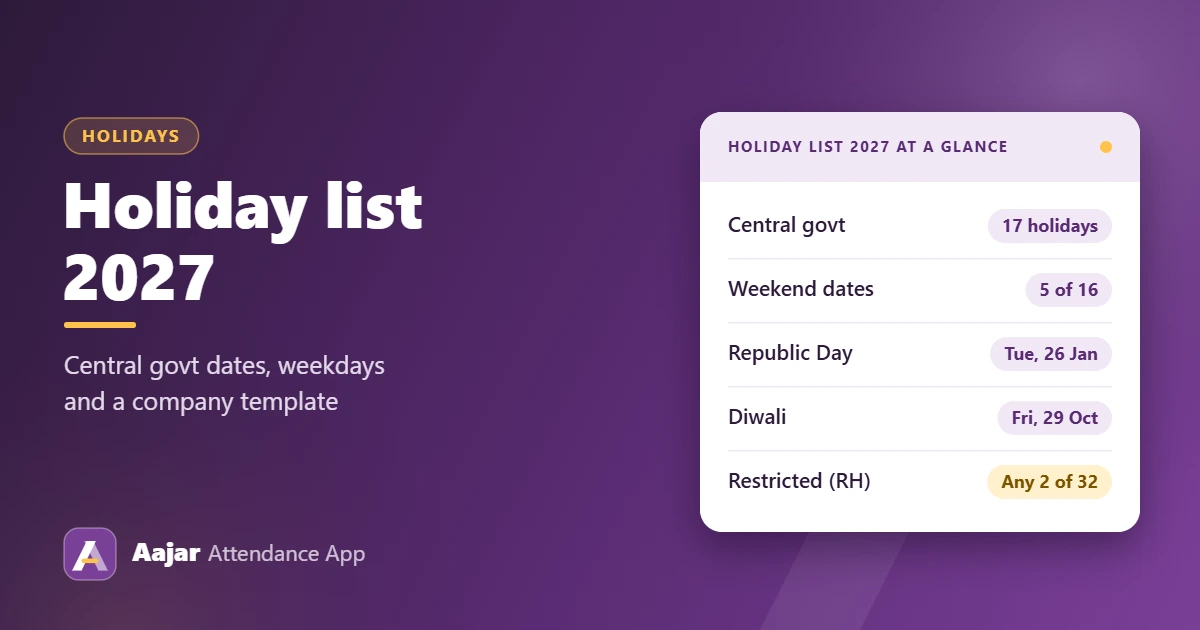
Holiday List 2027: Central Govt Dates and Company Template
All 17 central government holidays for 2027 with weekdays, what is left of 2026, state festival holiday rules and a sample company holiday list template.

Leave Application Format: Letter and Email Samples for Office
Copy-ready leave letters and leave request emails for office, the six parts every application needs, and how to count your leave days.
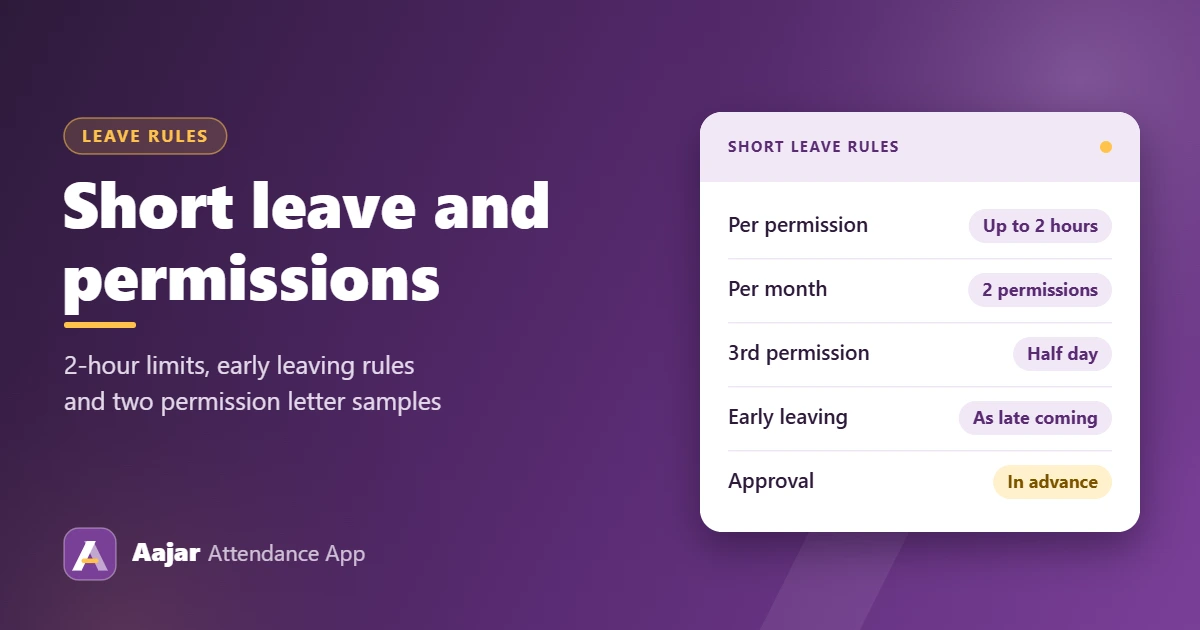
Short Leave in Office: Rules, Limits and Permission Letters
How 2-hour permissions, monthly limits and early leaving work, how to record them, plus two permission letter samples for office.